


Wellington County exploring shift to Canadian vendors as it looks to cut U.S. spending
County spends about $800,000 annually on American products, services

GUELPH – Wellington County is looking at options to reduce how much business it does with the United States.
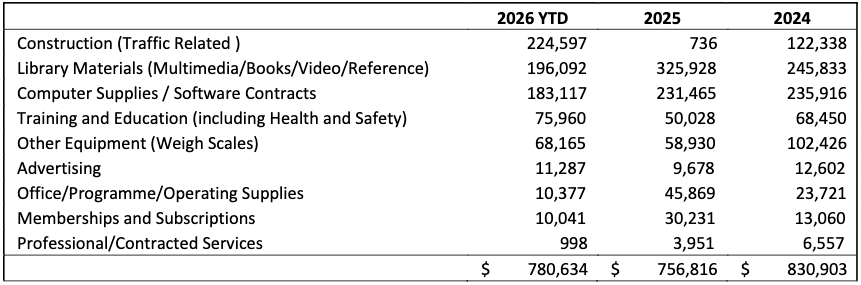
According to a report from county treasurer Ken DeHart, the county spent $756,816 in Canadian dollars with American vendors last year, down 9% from $830,903 in 2024.
However, spending south of the border this year has already surpassed the 2025 total, reaching $780,634 as of Aug. 31.
Traffic-related expenses are the largest spending category, accounting for 29% of all U.S. spending in the first eight months of the year.
County roads manager Joe de Koning stated in an email radar speed signs account for much of the $224,597 spent on traffic items, which is up from just $736 last year.
“We have such high spending in 2026 because we have utilized automated speed enforcement revenues to finance the purchases, and have doubled the number of radar signs on county roads,” de Koning said.
Spending was low last year because the county already had some radar signs in its inventory, he added.
American library materials have cost the county $196,092 thus far this year, while computer supplies and software account for $183,117, and training $75,960.
When it comes to library books, the county’s hands are tied, with major publishers and companies based in the U.S.
Chief librarian Rebecca Hine stated in an email the majority of U.S. spending is on digital media services, including e-books, audio books and educational devices.
Spending in 2025 was significantly higher than in 2024 or 2026 because the county spent $50,000 on educational devices for the new Erin library branch, Hine explained.
The budget for e-books and audio books was also increased that year to meet demand.
Hine said American authors and creators account for at least 75% of the library materials purchased through Canadian distributors.
"The Canadian book industry is so much smaller than the American one," she said.
"We purchase popular and critically acclaimed materials that our patrons want, regardless of the nationality of the author or the publisher."
Councillor and county finance committee chair Earl Campbell told council at a Sept. 24 meeting the county has "little choice" in where new library materials are purchased.
The county also has little control when it comes to software, Campbell added.
DeHart stated email software spending is trending up from last year because maintenance and contract costs are increasing.
The county is also spending $56,000 this year on the digital mental wellness app Calm, included under training/education as part of the county’s employee wellness program.
The remaining $19,960 of $75,960 in spending under the training/education category is related to software training, according to DeHart.
Council heard last month the county spends under $1 million annually on U.S. products and services.
“Less than one half of one per cent of our annual spend,” Campbell said at the September meeting.
The report follows a 50% tariff imposed by U.S. President Donald Trump on about $28 billion in Canadian goods in August, and Canadian counter-tariffs on U.S. goods the tune of around $27.6 billion last month.
DeHart said the county isn’t “directly” paying tariffs on any of the goods and services it purchases.
If the county is paying tariffs indirectly, it would be insignificant, DeHart said, noting much of the county's spending is exempt from the latest tariffs.
The county doesn’t have a specific target to reducing U.S. spending, but finance staff are looking for Canadian suppliers of equipment and construction materials.
DeHart said it’s unlikely the county can claw back spending in other areas, such as library materials and computer software and training.
“We won’t be able to materially reduce those costs on our own as there are limited options outside of the major players,” DeHart said.
The decision to replace some county business with domestic suppliers, beyond what the province requires through the Buy Ontario procurement directive, falls to council.
“We have made the commitment that we will do our due diligence on reviewing the county’s overall U.S. spending and source Canadian suppliers wherever possible,” DeHart said.


