

Atlookan brothers spread message of respect, forgiveness, hope
Pair spoke at arts centre on National Day of Truth and Reconciliation


ELORA – In his work as a social worker and mental health practitioner, Carl Dalton, of Dalton Associates, has worked in remote communities and formed relationships with Indigenous people.
So, on National Day for Truth and Reconciliation on Sept. 30, he was delighted to introduce brothers Leo and Elmer Atlookan to some 100 people who came to the Elora Centre for the Arts for a day of reflection and learning, with both afternoon and evening sessions.
The brothers grew up in the Eabametoong First Nation, a fly-in community north of Thunder Bay, which offered a hard life but one where they learned to live off the land, largely from lessons taught by their grandfather.
They could have become bitter about what colonists and then the Canadian government had done to them and their people.
They could have raged about a lack of health care, lack of schools, lack of clean water, lack of opportunity and the decline of their traditional ways of living.
And the impacts of the harm done to Indigenous people, when children were taken from their families to attend residential schools where they weren’t allowed to speak their language or observe their customs, continues to this day.
But instead, Leo and Elmer told stories of how they found it in themselves to forgive and accept their history. And they explained the reasons they chose to educate others about their culture, to lobby for their people, and to move forward with their lives rather than allow anger and bitterness to control them.
Elmer acknowledged his ancestors, “who used to hang out with tribes in this area,” he said, and his grandfather, who was one of the first elected chiefs to be recognized by the Canadian government.
Then he played a few songs on various flutes he had brought, which sounded a bit like a loon in the distance.
“I’m going to sing a song that passed from my grandfather to my father, to me and from me to my son and grandson,” Leo said.
“Go Leafs go!”
Leo was dressed in cultural regalia, with fabric covered with the Leafs’ logo, making for an amusing moment.
Elmer said they learned just 10 years ago that their father was a residential school survivor. He had kept that information from them growing up but decided to tell all before he died.
“I’m a day school survivor,” Elmer said, adding he spoke Ojibwe growing up, “but they squeezed it out of us.”
In remote communities with no high school, students to this day have to leave the reserve and live with family or billets in larger centres to attend high school.
Elmer said he was having none of that and quit school to remain on the reserve. He had to teach himself Indigenous skills like dance, like playing the flute, like reclaiming his language.
“My goal was to keep our traditions alive knowing we had something done to us. It’s never too late to understand your culture,” he said.
Leo also left the reserve and finds city life so fast, he said.
“I came here to find things to help my community,” he said. “Especially mental health. Since I was 17, I wanted to work with youth and help people with mental health issues.”
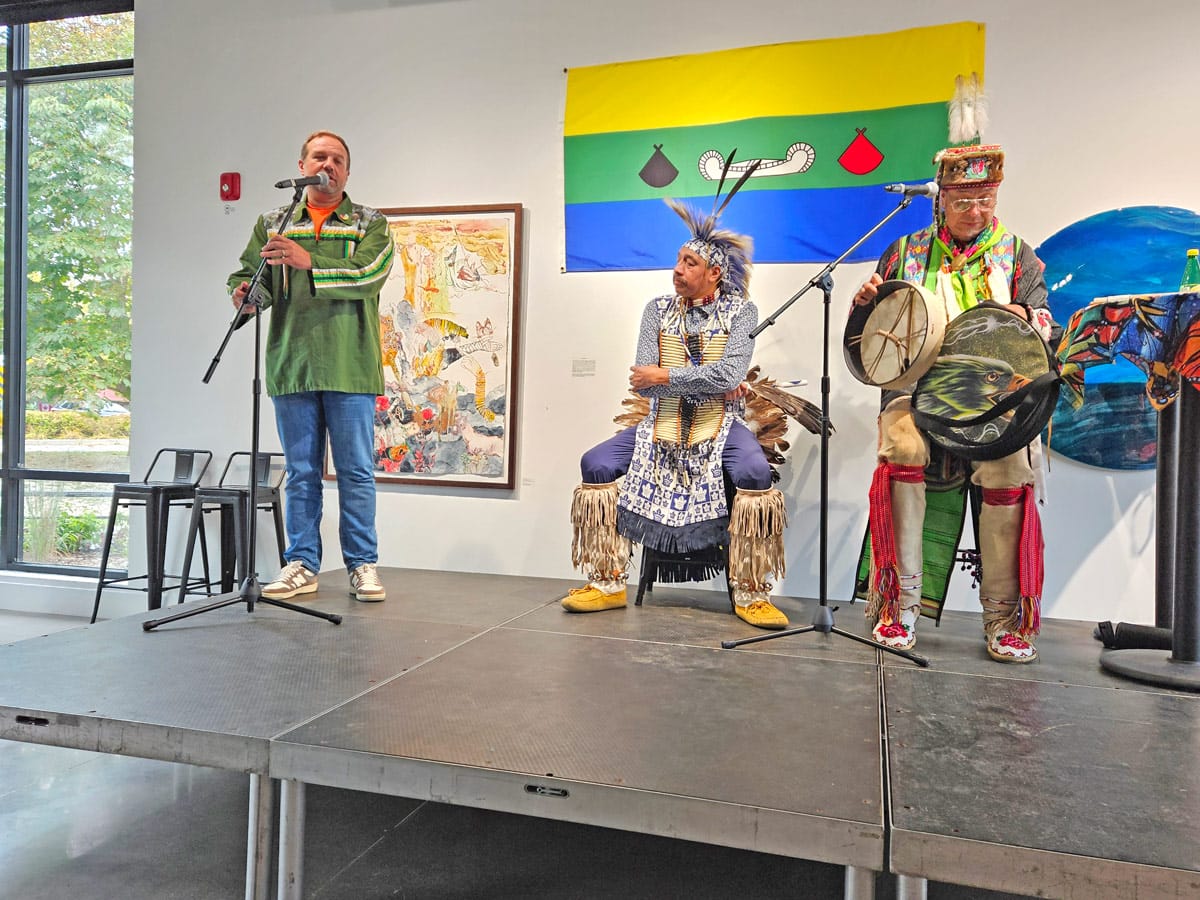
Dalton asked the men what it’s like for their community to be evacuated twice – once because of a forest fire and once because the water system failed.
The entire community was taken to the Niagara region for a long period of time. Elmer said it was triggering for many community members. Memories of being taken from their homes flooded back.
“And moving from the reserve to a big city – that’s big stuff,” he added.
Leo said he went with part of a mental health team and felt good that supports were available for those who needed them. “It’s hard living up there. All the stuff you need has to come from elsewhere,” he said. But it’s also hard living off the reserve, the place that is home in their hearts.
Leo pointed to the flag of the Eabametoong First Nation Reserve (Fort Hope) hanging in the backdrop. The yellow band represents the sun, the green is the land and blue is water. The symbol on the left represents the past, the one in the centre is the now, and the one on the right represents the future.
It’s a hopeful message, he said, and he’s hoping for a brighter future for young Indigenous people.


