


A relapse, a documentary, a life decision: will Alicia Newell make the cut?
Woman considering amputation will be featured in film documenting difficult choice

CENTRE WELLINGTON – A shared dark sense of humour, a love of rock climbing and the gruesome realization that two friends might one day both know what it’s like to lose a limb.
In talking about their grim realities and uncertain futures, Alicia Newell and Nick Sabia thought their conversations might be a good topic for a documentary.
It has morphed into something bigger and now the two are working on a film with the Canadian para-climbing team as it prepares for its inaugural event at the 2028 Paralympics.
“We tried to film a few of our conversations,” Newell said in an interview at her home on the border of Guelph/Eramosa and Centre Wellington townships.
“Turns out we are not filmmakers.”
Luckily for them, Newell’s friend Tyler Burr is, and with his help they made a pitch video at the Banff Film Festival. That video made the finals, and their effort received financial backing from Beyond Boundaries Films.
They hope to wrap filming in 2027 and their documentary Making the Cut should be complete before the 2028 Paralympic Games.
But let’s back up a bit. Who are these people and why does this matter?
Sabia, who lives in Guelph, was always an athletic guy and enjoyed a lot of sports. In 2019, at the age of 25, he was hit by a car while riding his motorcycle and had his leg amputated below the knee.
He tried a lot of sports during his recovery: weightlifting, cross fit, cycling, climbing. Running, he discovered, was off the table as it was too hard on his leg.
“I was looking for anything to exert myself and not re-injure my leg,” Sabia said.
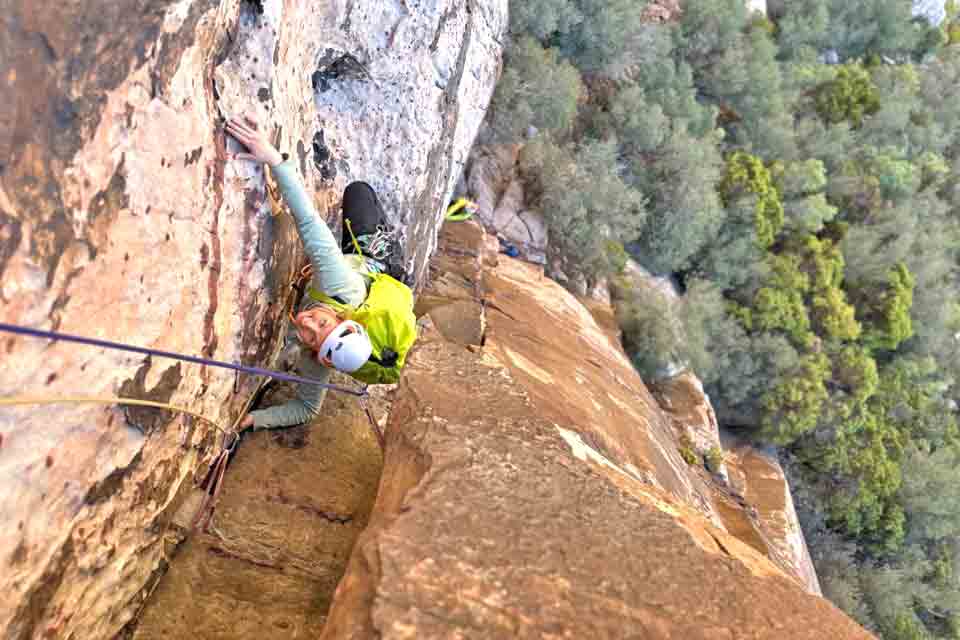
Newell is also pretty active and the two met at crossfit class where they became friends. They then started rock climbing together – a sport that on the surface seems an odd choice for a man with one leg.
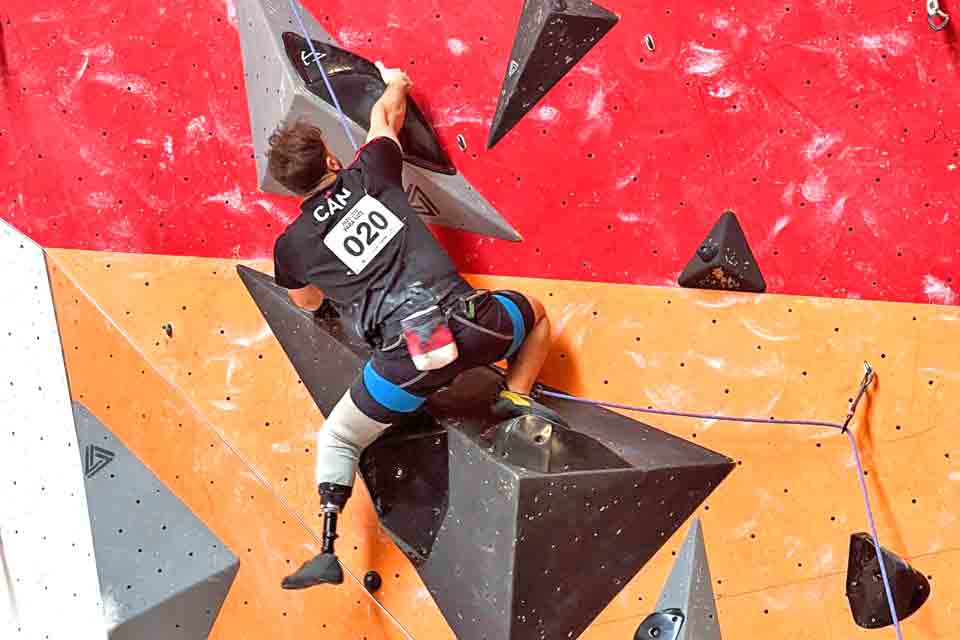
“For me, the risk of injury is less,” Sabia said. “I’m not putting impact on the residual limb.”
“It’s also very freeing, and amazing when you get to the top of a cliff,” Newell added.
During that time Sabia also discovered Canadian Adaptive Climbing, a group dedicated to removing barriers for people who face physical, mental and emotional barriers to climbing. Here he found community.
“They are very encouraging, and slowly I got into the adaptive community,” Sabia said. “And I got comfortable with climbing. After a few competitions, I found myself on the team.”
That’s the Canadian para-climbing team and 2028 will be the first year para-climbing is a sanctioned sport at the Paralympic Games that will be held in Los Angeles in August of that year.
“It’s scary at first,” he acknowledged. “Before each climb you look at the routes and find your beta. Everyone finds their own way to solve the problem.”
The problem: that’s the wall.
Beta: that’s the route each climber finds for themself based on their height, weight, ability and disability; where you put your fingers, where you put your feet as you scale a wall.
It is both an indoor and outdoor sport.
Sabia said people in wheelchairs can climb, as can people missing arms or legs and even people who are blind.
“It’s incredible to see them do it,” Newell said.
In 2023, Newell injured her knee and that turned into a fungal infection. It was a long rehab for her, but in May of 2024 her treatment ended and she appeared to be free of infection.
It didn’t last.
In January of 2025 she relapsed and started treatment again. That involved a cocktail of drugs that made her hair fall out, left her sick and fatigued all the time and unable to live her life as she had been doing. And the infection would not go away.
That’s when Sabia brought up the idea of amputation. And that’s when their deep, dark and very real conversations started.
Sabia said most doctors go to great lengths to save the limbs of patients faced with amputation.
It seems life would be easier with two legs after all, but the reality can mean a life of pain, chronic infection and multiple surgeries, just to keep a leg that will never work properly, he said.
Leg amputation isn’t easy either. There are often nerve ending issues and he has to take care of the area where his prosthetic meets his skin. Sweat is not his friend, he said.
“I struggle with those things,” he explained. “But I had a good team of doctors, lawyers, prosthetists and physiotherapists. I was able to get back fairly quickly (after the amputation). I was skating within four months.”
And now Newell herself is considering elective leg amputation. Hers would be above the knee to remove all traces of infection.
She’s talked with Sabia, she’s had discussion with some of the paralympic climbing team about life as an amputee.
And in September she’s taking the team to Canmore, Alberta for an adaptive training camp where the majority of the documentary will be filmed.
According to their pitch description, “She’ll manage resources, support and logistics, giving the team a chance to train together in the mountains, while Alicia learns from their experiences and reaches a decision regarding her own amputation.
“Between mountain views, irreverent one-liners and occasional prosthetic malfunctions, Making The Cut will prove that laughter in the mountains is the best medicine (next to anti-fungals), and introduce Canada’s para-climbing team through the eyes of someone who may soon stand in their shoe(s).”
On the day of the interview for this article, Newell was still undecided about her leg. She had been off the antifungals for about a month and was feeling pretty good about not feeling the side effects.
It’s a personal battle to be sure, but in many ways it’s a battle we all will face one way or another, she said.
“Every able-bodied person will face disability one day, through age, injury or illness,” she said. “So this film is all about the reality of what you can do.

