

Alex Graham reflects on Rockwood childhood, air force service


BRAMPTON – At 103 years old, Alex Graham has stories to tell.
He was five when he crossed the Atlantic on the SS Minnedosa in 1927, and it was his first time travelling.
With his parents and siblings, he immigrated from his home in Coleraine, Northern Ireland to a Marden farm, where his father Hugh worked for two years in exchange for passage on the ship and his family’s living expenses.
They moved into a home across from Waterside Park in Rockwood once Hugh finished his work in Marden. He started working on a turnip farm nearby, before getting a job with the Ontario Department of Public Highways.
The four siblings: Alex, Hughie, Wally and Dasie spent long days playing barefoot in the streets, woods and caves of Rockwood as soon as school was out for summer breaks.
Just like today’s youth, Alex said teens couldn’t wait to get their driver’s license when they turned 16 – and all the freedom that came with it. His brother Hughie loved old cars and would take all the lads out driving before the war, Alex said, when “gas was only 28 cents a gallon.”
But the Depression made life challenging, Alex said, noting “most people in Rockwood needed help.”
They got by on an honour system. Shopkeepers let people “put it on the tick,” Alex said, “and as soon as us lads went to work, the people we owed were the first to get paid.”
All three brothers enlisted
After the Second World War broke out, each of the three brothers eventually signed up to join the military.
Hughie and Wally enlisted first, and what Alex heard from them about the army “didn’t sound enticing.
“I particularly didn’t like their uniforms,” Alex said with a chuckle. “Or maybe it was just them in it, who knows?”
His brothers described mattresses with no sheets, only blankets, and strict curfews that meant they couldn’t stay out late at night.
Friends in the Royal Canadian Air Force assured Alex they had sheets, were left to their own devices at night, and had sharp uniforms.
The air force men were considered the “gentlemen of the military,” Alex said, so that’s where he decided to enlist in 1942.
Like most joining the air force, Alex said he wanted to be able to wear the little white insert in his cap that signaled a pilot in training.
“Of course, I didn’t make it as a pilot,” Alex said, so he joined the air force’s ground crew instead.
He was stationed at three different Elementary Flying Training Schools in Ontario, Alex said, where he helped the pilots fly by keeping planes in order, gassing them up and starting them by turning the propellers.
Then Alex went to Halifax and, along with thousands of other air force service members, boarded the SS Île de France and headed for England.
“A highlight of the transport across was having a shower,” in cold ocean water, Alex said, with a pail of warm water to rinse for the lucky ones.
Eventually, the same ship would bring Alex home to Canada after the war.
Alex said the ship had to zigzag its way across the ocean to avoid German U-boats (submarines). The ship was so full there was hardly space to sit down, Alex said, but he had fun and made friends.
“I had a wonderful group of friends in the air force,” he said, “we had such a great time in England.”
When the 5,000 or so air force members arrived, Alex said officials weren’t sure what to do with them, so they sent them on “vacation” while they figured it out.
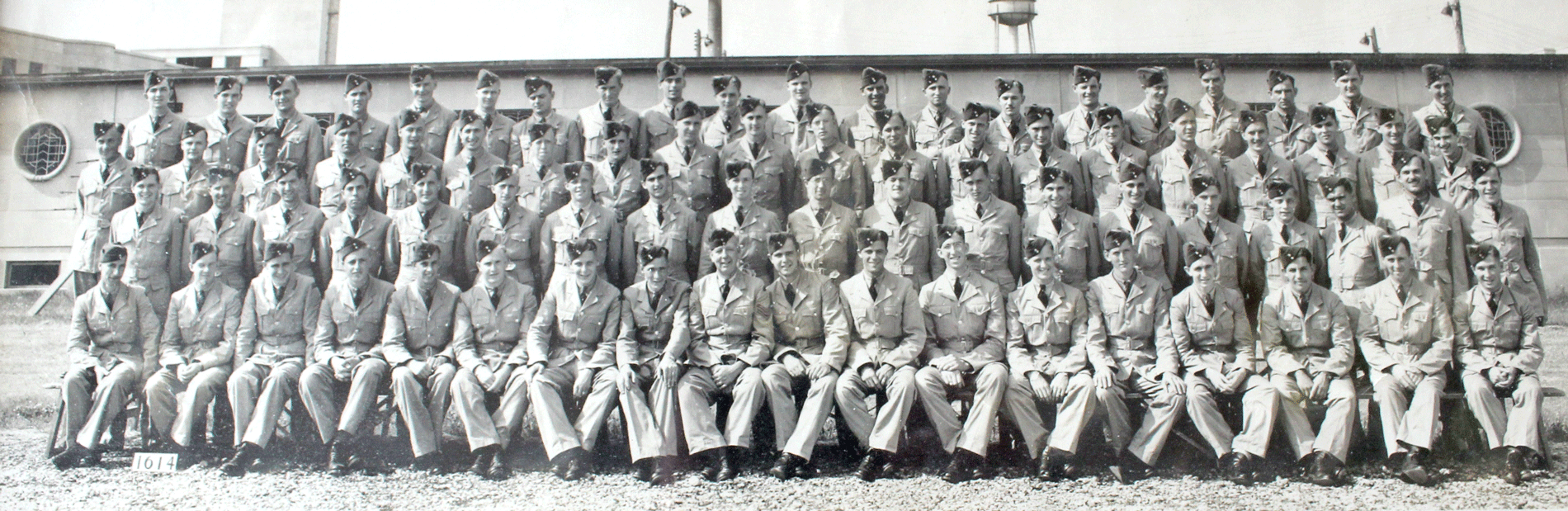
Alex took that opportunity to return to Coleraine.
When he got back to England he was assigned to an army base in York, where he worked on Lancaster bombers – gassing, starting and maintaining them and assisting pilots.
He then moved on to Holland, where he said locals were grateful to see them.
“Some weekends we were given a small roast beef, potatoes and carrots and told to ‘go into town, pick a house, and say you came for dinner. But don’t eat too much – leave leftovers.’
“We saw what families in Holland were going through, when husbands were taken to Germany,” he said, noting some people couldn’t afford shoes so wrapped their feet in burlap cloth instead.
Asked what he learned during his service, Alex said “It was not just me I was looking after – I was helping to protect our whole little group.”
Thanks to a pilot he served with in England and Holland, Alex learned how to fly. The pilot wanted to get up in the air as much as possible, so went on what he called “weather trips” in the mornings. Alex would start up the plane and go along for the ride, and over time the pilot taught him to take over the controls.
In Dutch farmers’ fields, Alex said they would put artillery guns back in place after they bounced off target. That’s where he was when he and the pilot got a call to return to base on May 8, 1945.
When they flew into the base and saw soldiers celebrating and hugging one another, “We knew right away it was the end of the war.”
Alex said they turned to each other as the realization set in: they survived. “We’re still alive! We’ll be going back home,” he recalled thinking.
Life back home
Asked what he had missed most, Alex first thought of his friends.
He knew many had joined the war effort but didn’t know where they ended up – or whether they survived. He wanted to get home to find out who made it back alive.
While serving overseas, Alex said he didn’t know much about the war – he learned far more once getting back.
Alex missed his parents, too, and “the wonderful Irish stew” his mother Sarah Jane, or Sadie, used to make.
And he missed Saunders Bakery – especially their ginger snaps and cakes.
He missed the odd jobs he did around town, like delivering the newspaper and building wooden bird boxes with a friend.
Alex said he was fortunate enough to come home to a job, unlike many of his peers and his brother Wally, who had to move in with their parents, even after starting families in England.
He’d been hired at Bell Telephone straight out of high school and that’s where he worked until retirement.
The brothers catch up
Alex’s oldest brother had been training new recruits to operate tanks at Camp Borden. Officials there wouldn’t let him leave to serve overseas, Alex said, so that’s where Hughie completed his service.
But Wally was on the front lines from the beginning, Alex said, and was lucky to survive.
“He did everything in the army,” Alex said.
Wally loved dispatch riding, but was a humanitarian and didn’t like being a sniper, Alex said. “He didn’t want to shoot anyone, not even a German guy.”
He once saved an officer’s life, Alex said – German planes were flying low overhead and Wally “yanked the officer out of the vehicle and into a culvert along the road” just in time.
During the Battle of Normandy on D-Day, June 6, 1944, Alex said Wally fired at the Germans through pillboxes on a ship, and “that’s how he survived – because he remained on the ship.”
Alex said he and his brothers never spoke much about their experiences in the military, but “I wish I had.”
After returning from the war, Alex moved to Brampton and met his wife, Ethel, through friends who invited them both to a dance at their local Legion.
“We got along so well,” Alex said, and they were together until she died of lung cancer in 2008.
Alex seems to be doing well. He’s been retired for 47 years and has an active sense of humour, at times even laughing by himself, he said.
Still in Brampton, he lives independently in his apartment with a little assistance from a kind neighbour, a meal delivery service, and twice-daily visits from Spectrum Health Care.
He’s considered moving to a retirement home, but getting rid of his things to downsize feels daunting, and he wishes he’d tackled the task a few years back instead.
He reflects fondly on his early years in Rockwood, and still goes back to visit.
“I remember every school teacher by name,” he said, adding how, unlike in bigger cities, everyone knew each other – the good and the bad.
He would love to see photos of him and his brothers on the banners that hang throughout the village for Remembrance Day.
Alex kept on driving until late last year, when he sold his car and replaced it with a scooter he uses to run errands.
And last year, Alex got to put his flying skills to the test when a family friend took him up in a plane.
“I crawled up the wing to get into the passenger seat,” Alex said, and they made their way over the QEW to Niagara Falls. “We got up into the air, and he said ‘take over.”

