

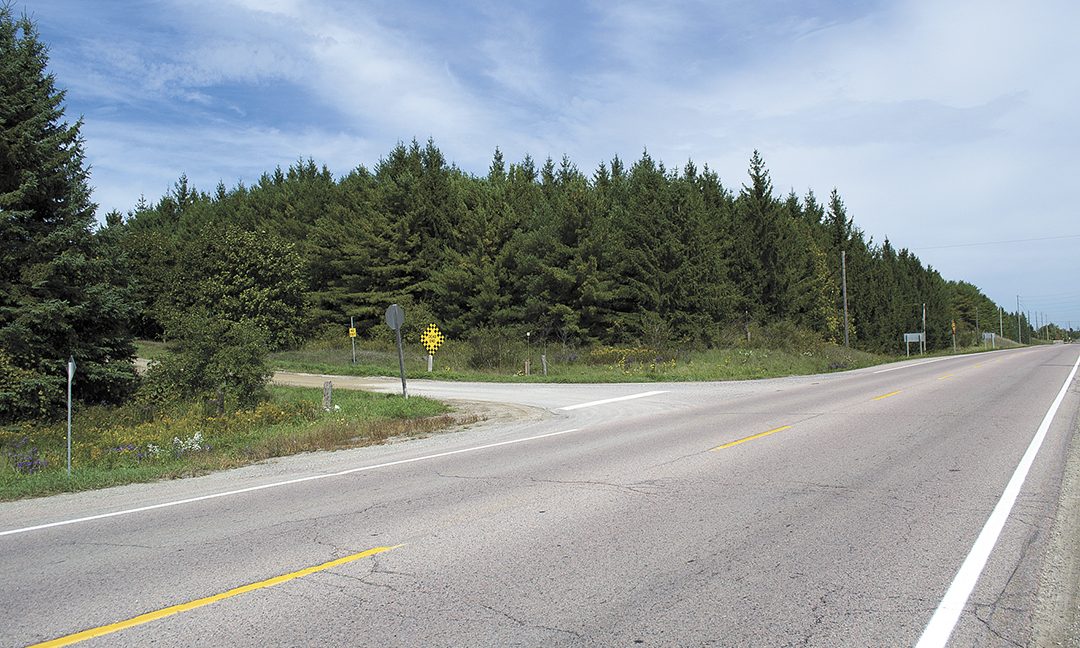
GUELPH/ERAMOSA – The province has green-lit a new aggregate operation 13 years after James Dick Construction first applied to tap into a dolomite deposit at the so-called “Hidden Quarry” southeast of Rockwood.
The Ministry of Natural Resources issued the licence on Oct. 31 – and posted its decision online on Dec. 5 – permitting the company to extract 700,000 tonnes of aggregate yearly from a 60-acre open-pit mine roughly the size of five Stone Road Malls.
The company has owned 96 acres at the northeast corner of 6th Line and Highway 7, where the operation is located, since 1989.
Doug Tripp, the leader of a now-defunct opposition group, the Concerned Residents Coalition, was surprised to learn the licence had been issued.
“It’s been crickets” for more than five years, Tripp said.
The former non-profit’s 12 board members shared many of the complaints commonly associated with quarries: flyrock, haul truck volume, noise, dust, et cetera.
But at the top of the list, Tripp said, is the potential for groundwater contamination from mining activity.
James Dick vice president Greg Sweetnam said quarries across the province haven’t proved a problem over hundreds of years.
“There’s not piles of bodies stacked up around those quarries,” he said. “We have lots of data about how there’s no impact on water.”
Tripp said subaqueous extraction, that is mining underwater without dewatering the area, carries unknowns.
“One thing is sure … the contaminants from blasting, the materials that are used in the blasting, will end up in the water,” Tripp said.
“In the southern United States, the only way they mine rock is by blasting it down into ponds and dredging it out,” Sweetnam said.
“It’s never been used in Ontario because everyone uses the old-fashioned method of putting a pump down at the lowest elevation and pumping like hell.”
“We can actually get approvals using this technique and you can mine smaller sites,” Sweetnam later said, adding it’s likely the future of aggregate mining in Ontario.
Tripp said he and others are beyond disappointed, but the quarry was a foregone conclusion with an Ontario Land Tribunal decision in 2020.
Local government and residents have opposed the quarry since it was first proposed in 2012, when the company applied to amend a Guelph/Eramosa bylaw to allow aggregate extraction.
The township failed to make a decision on the request for years, and so did Wellington County, leading to a six-week land tribunal hearing in 2019.
The tribunal’s decision to allow the quarry, issued the following year, was contingent on James Dick meeting 12 conditions, including forming a community liaison committee, funded by the company, to keep tabs on the quarry.
The first community liaison meeting, to discuss road construction, will likely be held in the spring, according to Sweetnam.
Anyone living within 500 metres of the site can join the committee, which will have two James Dick representatives. Anyone will be free to attend.
‘Project development workshop’
“It’s almost a fool’s errand to try to fight these things on a scientific, technical basis; it’s got to be made political and we’ve got to be able to influence decision makers in government,” Tripp said.
He has taken the lessons learned through the fight against Hidden Quarry — what he criticized as a “project development workshop” for the aggregate industry — into the Reform Gravel Mining Coalition, a non-profit working against open-pit mines across the province since 2023.
Stephanie De Grandis, a Gravel Watch Ontario member who belonged to the former residents’ coalition, said the quarry threatens the health of a tributary flowing under the James Dick property from a spring-fed pond on her property.
Eventually the tributary travels under Highway 7, turns into Bryson Creek and then Blue Springs Ceek, before feeding into the Blue Springs Creek Wetland Complex. She said brook trout in the creeks should be protected.
De Grandis lives north of the quarry and runs a cattle operation under the name Walnut Hill Tree and Critter Farm.
She worries a shallow, dug well on her 210-acre property will drop as water flows to fill the cavity that will be blasted into the land next door.
“What will this quarry do to the water table and well systems around the area?” she asked.
“The bottom line is that we really don’t know, there hasn’t been multiple studies of these kind of aggregate extractions, we can predict but we don’t know.”
According to Tribb and De Grandis, the former residents’ coalition spent $800,000 fighting the quarry. A “horrible failure,” De Grandis said of the loss.
Natalie Jaroszewski, who grows mushrooms at W&T Mushrooms with her father Witold Jaroszewski, said she didn’t want to provide immediate comment.
With property abutting the quarry, the Jaroszewskis have been outspoken against it in the past, previously saying the operation could contaminate water used on their crops.
‘Extremely frustrating’
Guelph/Eramosa Mayor Chris White, who has been on council since the quarry was first proposed, said it was a “brutal” and “long, drawn-out” fight outside of the township’s control.
Council resisted the quarry because of its proximity to Rockwood and drinking water wells. But provincial priorities trump local ones, the mayor said, referring back to the tribunal’s decision.
“I think people find that extremely frustrating from a local perspective,” White said.
Outside of a condition for James Dick to repave a portion of 6th Line, the mayor said the township isn’t kept apprised of developments.
Sweetnam told the Advertiser the land tribunal’s conditions have been met over the past five years, but the project was bogged down in bureaucracy at the province over approvals for turning lane modifications on Highway 7.
Trees still need clearing; vegetation, topsoil and gravel is to be stripped; a scale house and entrance need to be built; road construction has yet to start; and fencing and water monitoring systems aren’t yet installed.
Sweetnam said that’s only a portion of a large to-do list; it could be three to four years before the operation transitions from a gravel pit to a fully-functioning quarry.
Blasting, lasting for about a second at a time, 14 to 22 times per year, won’t start until the quarry takes shape, according to Sweetnam.
Relative to quarries with millions of tonnes of yearly extraction, Sweetnam said Hidden Quarry is a “tiny mom and pop thing.”
‘We need theses things’
He struggled to comprehend why some would so vehemently oppose a quarry he argued would have no impact on surrounding residents.
“This thing isn’t as bad as what you think it’s gonna be, and we need it; as a society, we need these things,” Sweetnam said.
With massive quarries likely bygone because of a lack of available land, Sweetnam said smaller sites like Hidden Quarry are crucial for supplying high-quality material for high rises and transportation infrastructure.
“We’re going to need a lot of material in the future and we’re already starting to get to the point where we’re running out,” Sweetnam said.
“We have to go to places like Guelph/Eramosa where it physically is.”
Bedrock will be blasted and extracted below the water table over the next 20 years, ponds dredged to recover dolostone belonging to the Amabel Formation, deposited some 400 million years ago in the ancient sea of the Michigan Basin.
Dolostone is a calcium carbonate rock similar to limestone, but it contains the mineral dolomite. High in levels of calcium and magnesium, dolostone is resistive to acid and sought after for construction material.
Once the quarry is running, around 270,000 square metres of rock will be trucked out each year to concrete and asphalt plants in the GTA and used for high-rise buildings, bridges, roads and sidewalks.