


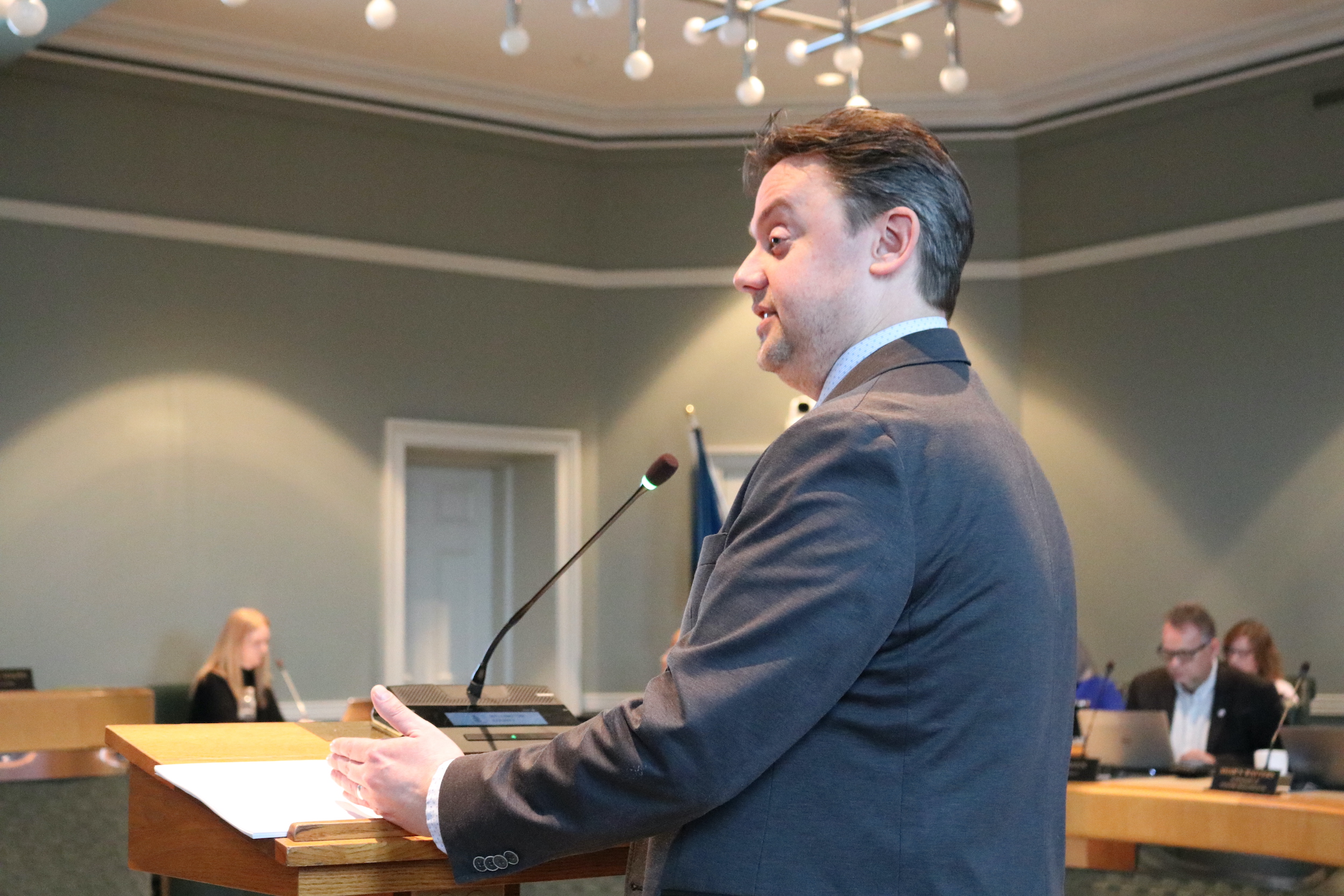
GUELPH – The county is projecting a tax increase of 3.5 per cent this year with increases closer to 5% in 2027 and 2028, largely due to “pressures” in the social services department.
The county’s proposed 10-year plan was presented to council on Jan. 12 by treasurer Ken DeHart, including updates to the proposed 2026 budget that was last shared with council in November.
The plan originally projected a 3.5% increase this year and increases ranging from 2.5% to 3.8% between 2027 and 2035.
On Monday council learned the 2026 increase remains unchanged, but “2027 and 2028 have increased” to 4.1% and 4.9%, DeHart told council.
“We’re continuing to see pressures on our rent supplement supports and our homelessness prevention program,” he explained.
The operating budget in 2026 is estimated at $387.2 million “and we have just under a $700-million capital investment over the next 10 years, including $78.6 million in 2026,” DeHart said.
The operating budget is forecasted to grow to $493.6 million by 2035, which includes an average annual increase of 3.1% over 10 years.
DeHart noted the county is expecting to issue $90.2 million in new debt over the next 10 years, “most of which is going to be allocated to growth-related projects ($79 million).” The remaining $11.2 million is tax-supported debt.
The roads department is accounting for approximately $466 million (68%) of the total 10-year capital budget ($686.6 million).
Proposed capital spending this year is $58.3 million, including:
- $16 million for roads construction;
- $14.5 million for bridge and culvert replacement and rehabilitation;
- $12.3 million in facilities; and
- $4.4 million for equipment replacement.
“Between roads, housing and ambulance, that makes up over 85% of the county’s [10-year] capital budget,” DeHart said.
Several councillors raised concerns about the construction of ten proposed ambulance stations – eight in the county and two in Guelph – over the next 10 years.
“I find it interesting that neighbouring municipalities are building ambulance stations that are about a quarter of the cost that’s being estimated in our area,” councillor Mary Lloyd said.
“There are different realities in terms of construction costs in municipalities that are located closer to urban areas than others,” DeHart replied.
“These construction costs differ even across the County of Wellington. They tend to be higher in the south.”
Councillor Campbell Cork said it will be important to visit other ambulance stations and “find out what they’re doing.”
Chief administrative officer Scott Wilson told Cork he received information regarding a Grey County construction project and staff will investigate.
The proposed Guelph/Eramosa station to be built in 2029 to 2030 for $11.4 million caught councillor Doug Breen’s attention.
“What are we building?” Breen said. “That number is crazy to me.”
DeHart noted the estimates listed are “very preliminary and based on land acquisition costs.”
Warden Chris White ended the discussion on ambulances stating, “Step one is the [City of Guelph] has to agree that they’re going to let us build them [and] that hasn’t been committed to yet.”
He added, “The idea is if the county [builds the stations] then [the project] moves a little quicker and there’s a little more motivation to get it done.”
Reserves and debt
In regards to the 10-year capital budget, the county will cover $446.6 million (65.1%) with reserves.
The current projected reserve and reserve funds total $141.1 million, with $78.53 million from capital reserves.
The projected balance at the end of 2026 shows a drop in the reserves to $137.3 million, partly due to spending $8 million in automatic speed enforcement revenue.
“We have been fortunate enough to plan ahead on our projects and try to limit the amount of debt that we have from a tax-supported basis,” DeHart said.
In the 10-year forecast, two projects have been narrowed down for tax-support debt: ambulance stations in Erin (2027 to 2028) and Mount Forest (2033 to 2034).
“Our trend line on our growth-related debt is trending in the wrong direction,” DeHart said.
He noted a growing community means “lots of growth-related expenditures, facility expansions, road widening,” DeHart added.
He added construction costs have gone up “significantly” since the COVID-19 pandemic.
“The other factor is provincial policy changes. The province … has been making lots of changes to development charge legislation,” DeHart explained.
The county has 20 cents in debt for every dollar it has in reserves, meaning “our debt is very manageable [and] we’ve got enough reserves to adequately handle our debt,” he concluded.
The 2026 budget and 10-year plan was received by council for information.
The full budget package is to be circulated to council by Jan. 23.
It will be reviewed by the administration, finance and human resources committee on Jan. 26 and returned to council with recommendations on Jan. 29.
