

WELLINGTON COUNTY – “Once you get that tree to knee-high, you’re okay,” said Derek Elliott, his voice booming with added emphasis, “You gotta get the trees to knee-high with the droughts.”
Droughts, and all extremes of weather, have become an increasingly undeniable reality afflicting the 418 Christmas tree growers across the province relying on the seasonal tradition.
Elliott, whose family has grown spruce and fir trees near Hillsburgh since 1983, said growing practices have changed in response to more noticeable droughts in recent years.
“Just five or six years ago, I went out to a field in July and we had lost half the crop,” Elliott said.
One of the largest operations in Wellington County, with upwards of 70,000 trees growing on 100 acres, the effect of such a loss is stark.
Each year, upwards of 4,000 seedlings are planted there, up from around 2,500 a couple years ago.
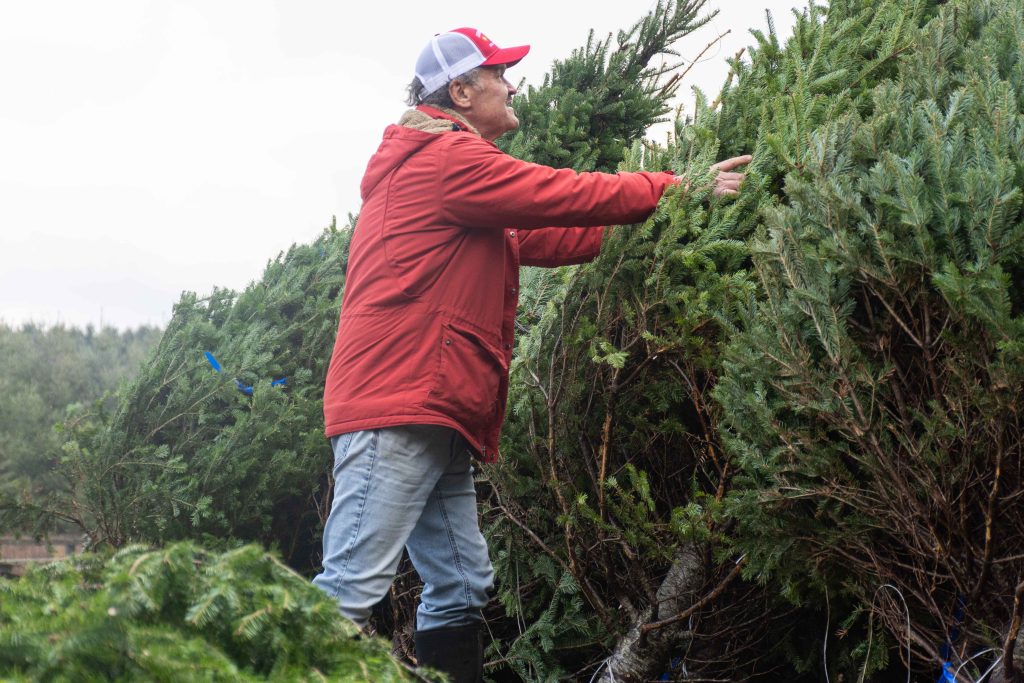
Derek Elliott of Elliott Tree Farm. Photo by Jordan Snobelen
Part of the increase is Elliott Tree Farm’s growing popularity, according to Elliott, with its refined agri-tourism experience (complete with a golden ticket granting admission to Santa’s cabin in the woods).
But Elliott is also planting more to account for seedlings being lost to more intense and prolonged heat.
Irrigation systems are either prohibitively expensive or impractical for many growers.
For Elliott, it’s both. He said it would make the price on a tree “pointless.”
Three to four years ago, Elliott trialed planting seedlings into a rye cover crop and found success, rolling the practice out across all newly planted acreage.
“You can walk out in the middle of a hot summer and open up (the rye) and there’s a beautiful little seedling, green as can be, sitting in there,” Elliott said.
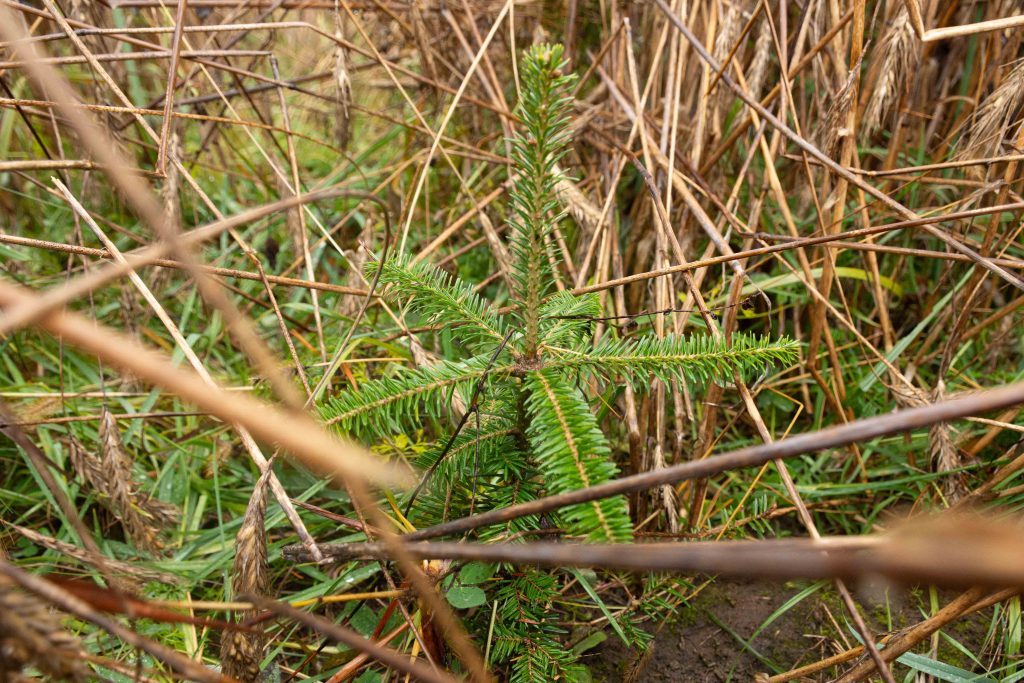
A young evergreen sheltered among the stems of a rye cover crop. Photo by Jordan Snobelen
Rye, a hardy cereal grain, controls weeds and shades young seedlings, providing a chance for roots to sink into the sandy loam soil. Seedings are also planted with a root development fertilizer.
If they make it three years, the tree will reach knee height and have roots extending far enough into the mix of sand, silt and clay below to survive an extended drought, Elliott said.
A 50km drive northwest of Erin, at Bell’s Creek Tree Farm just outside Riverstown in Wellington North, Brad Royce has paused cut-your-own trees this season, and is relying on pre-cuts to give his 20-acre farm a chance to recover.
“I’m dealing with drought issues from 10 or 12 years ago, where I lost seedlings,” Royce said, adding, “It’s a long-term domino effect.”
A tree is felled in minutes but it takes seven to 10 years – and year-round labour – for it to reach the six to eight feet needed to catch someone’s eye.
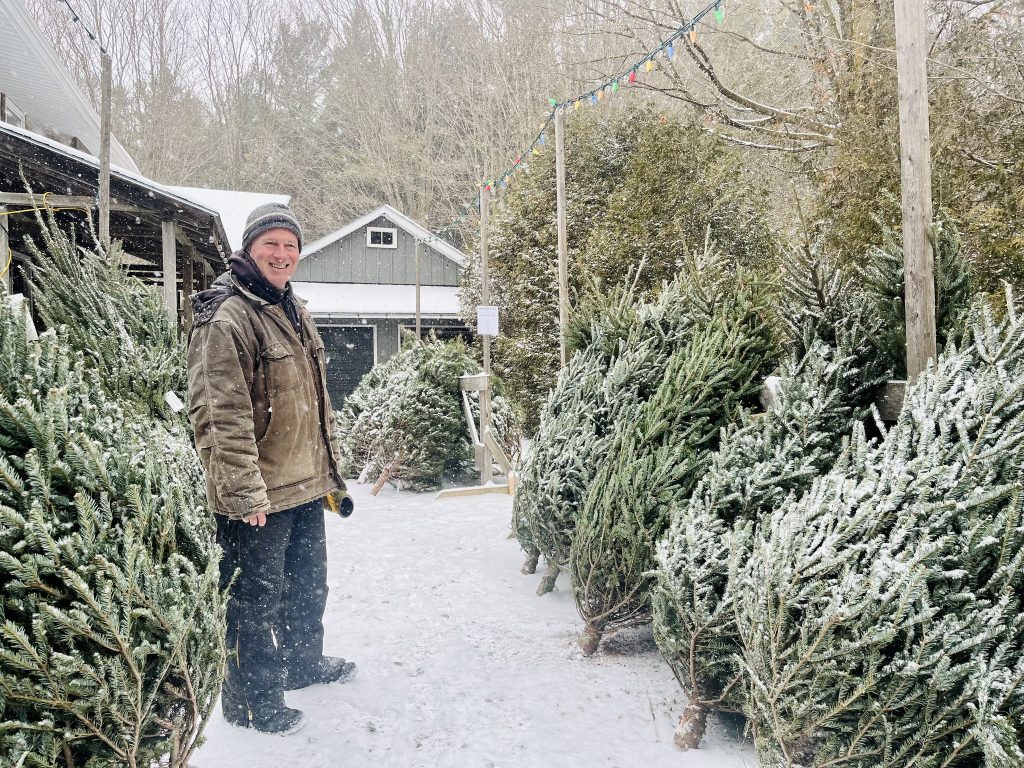
Brad Royce stands with pre-cut trees last season at Bell’s Creek Tree Farm just outside Riverstown in Wellington North. Submitted photo
According to Royce, last year was a brief reprieve between a “horrible” 2023 and this year’s dry spell. This year was the first in two decades Royce saw a late-summer die-off.
“It’s the very first time I’ve seen trees that drop dead like that, turned brown, and died in August and September,” Royce said, adding most of the victims were from a stressed 2023 crop. “As seedlings, they just never put down proper roots.”
Alison McCrindle said it’s a familiar refrain.
“We were fortunate this season compared to probably the majority of other farmers in the province,” McCrindle said. “I’ve talked to farmers who had thousands of seedlings lost.”
McCrindle, along with her husband Joe Wareham, has been a tree grower since 1997. In 2002, they opened Chickadee Christmas Trees in Puslinch, where they grow fir, spruce and pine varieties.
They had just enough rainfall to get by and not suffer losses seen elsewhere, but next year could be a different story.
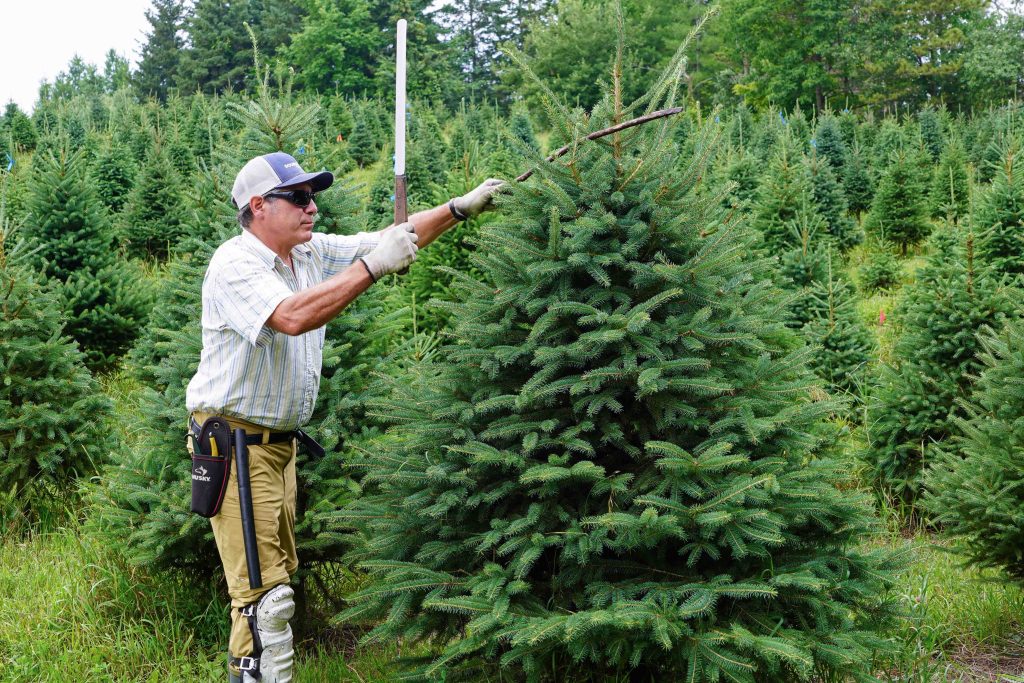
Joe Wareham shearing a tree at Chickadee Christmas Trees in the summer. Submitted photo
Temperature swings and how long they last are more intense and unpredictable in McCrindle’s experience, and she said springtimes have shortened as fall seasons have grown.
For nearly 30 years, they’ve relied on the calendar to know when certain things need to happen on the farm.
Now, they’re using “growing degree days” – a calculation based on a collection of temperatures.
“We can then calculate those degree days and say, ‘this is when we need to be looking for balsam twig aphid,’ for instance,” McCrindle explained.
Climate scientist Kelsey Leonard said tree growers are having to adapt to more extreme heat, intense and prolonged rains, and more insect and pest pressures.
Leonard founded the Christmas Tree Lab at the University of Waterloo, where she’s an assistant professor, to help growers weather coming storms.
Chickadee Christmas Trees is one of around 30 farms from Windsor to Ottawa contributing to a 2023-25 benchmark study to be released by Leonard’s lab.
“It’s basically a snapshot in time that allows us to track, based on growers’ scientific knowledge, the natural phenomena that they’re experiencing … and their growing activities,” Leonard explained.
The industry is adapting on its own. At Chickadee, McCrindle and Wareham are experimenting with mulch to hold moisture at the foot of young trees, but Leonard said growers need robust supports, like those of Europe and the U.S.
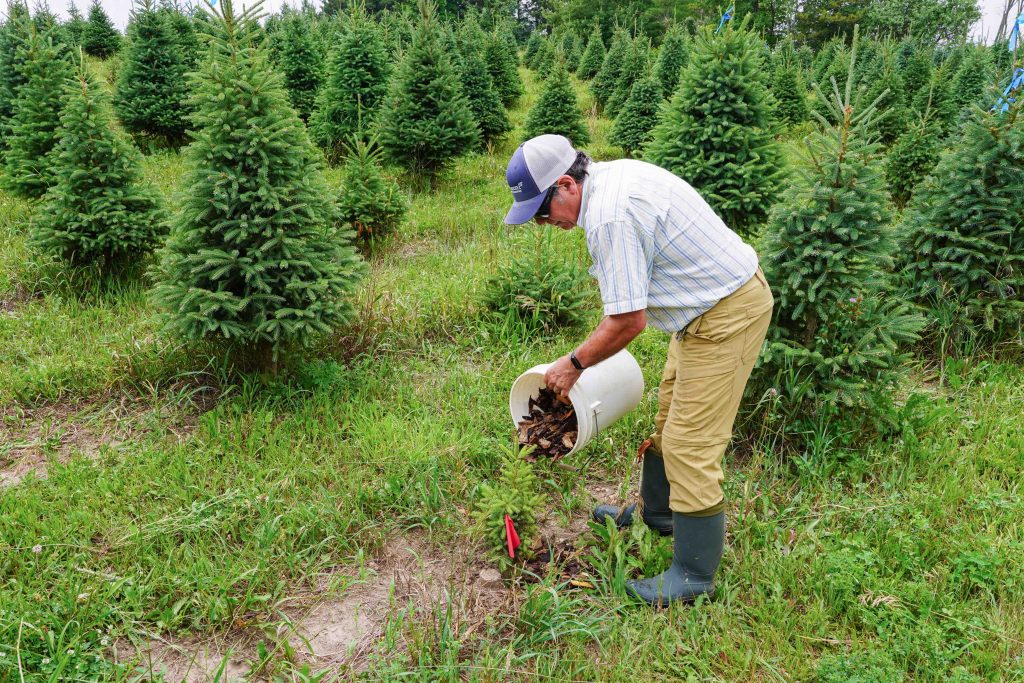
Joe Wareham dumps mulch to hold moisture at the foot of a young tree at Chickadee Christmas Trees. Submitted photo
The lab recently released a policy brief about how the Christmas tree industry is affected by a changing climate, calling for government action, inclusion in crop insurance policies, giving growers a voice in policy development and noting emerging concerns around pests and diseases.
“It’s really about how do we support Christmas tree growers through climate resiliency and sustainability tools that allow for the industry to continue to be a part of our holiday traditions now and into the future across Canada,” Leonard said.
The lab is also working with Christmas Tree Farmers of Ontario (CTFO)around climate change.
“It is changing enough that we’re taking notice of it,” CTFO executive director Shirley Brennan said. “First seedlings were the hardest hit this year.”
Losses ranged from 10 to 30 per cent for pine and spruce varieties all the way to total losses for spring planting of heat-sensitive firs, according to Brennan.
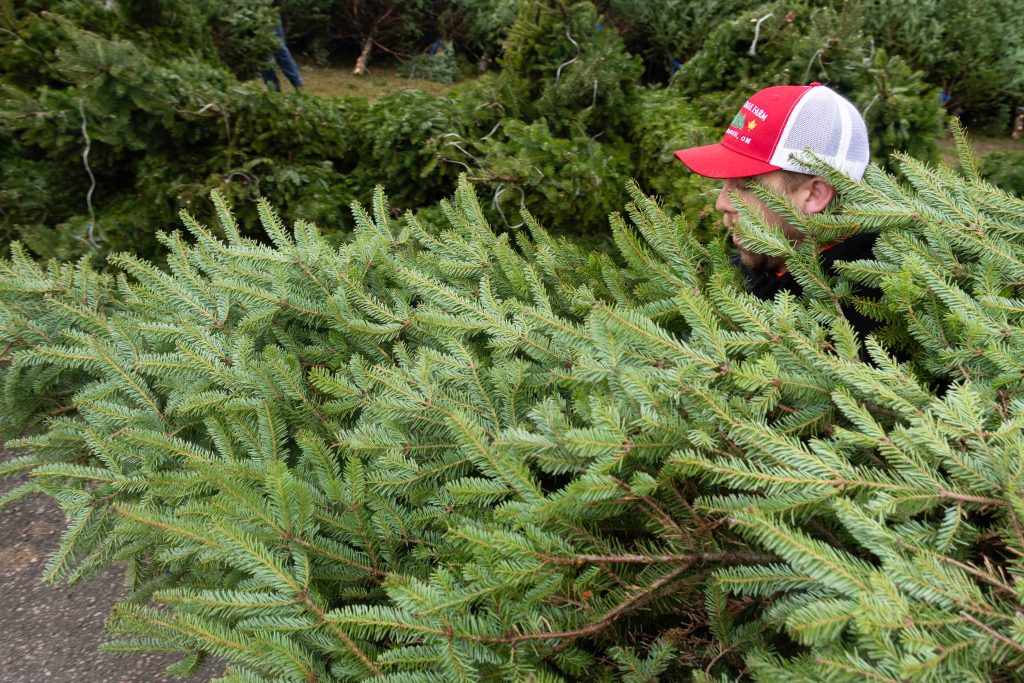
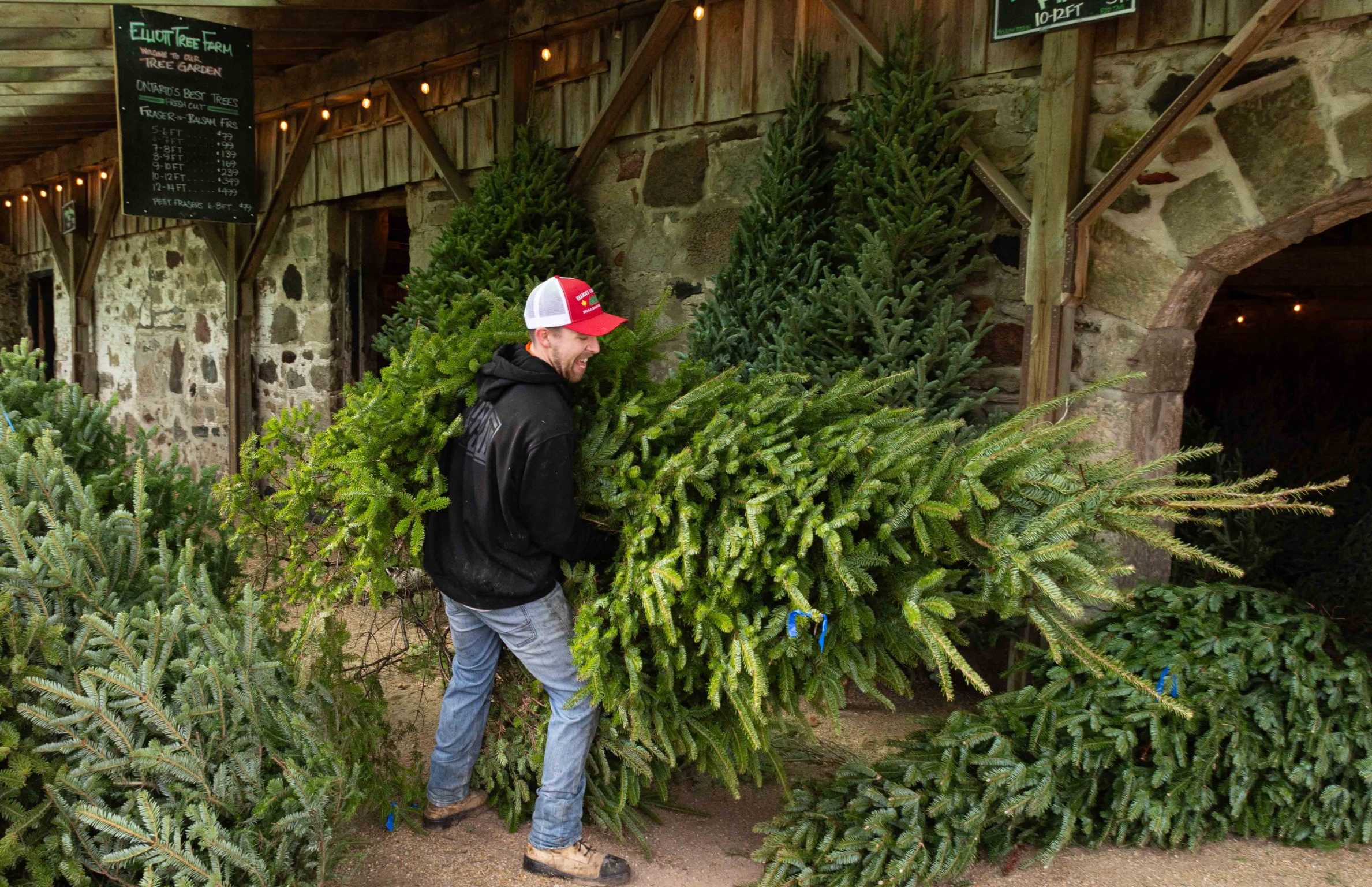
Travis Robertson moves a pre-cut Christmas tree at Elliott Tree Farm. Photo by Jordan Snobelen
Some growers are now augmenting spring plantings with fall plantings, giving seedlings a chance to establish roots in the wet autumn weather before entering winter dormancy.
Whereas spring plantings are threatened by a hot dry summer, the risk for a fall crop is a harsh early frost that could kill new growth buds.
Growers are experimenting with mulching around seedlings, hand-watering, cover cropping and changing field layouts – all to keep water in the ground.
“It’s a learning curve because the weather is changing, and how do we change and adapt,” Brennan said.
Change is nothing new for Christmas tree growers, Brennan added.
When customers began asking for more tailored, thinner trees, there was an industry-wide shift away from the large, bushy trees of yesteryear.
“Now we’re looking at adapting to something that’s out of our control,” she said.