

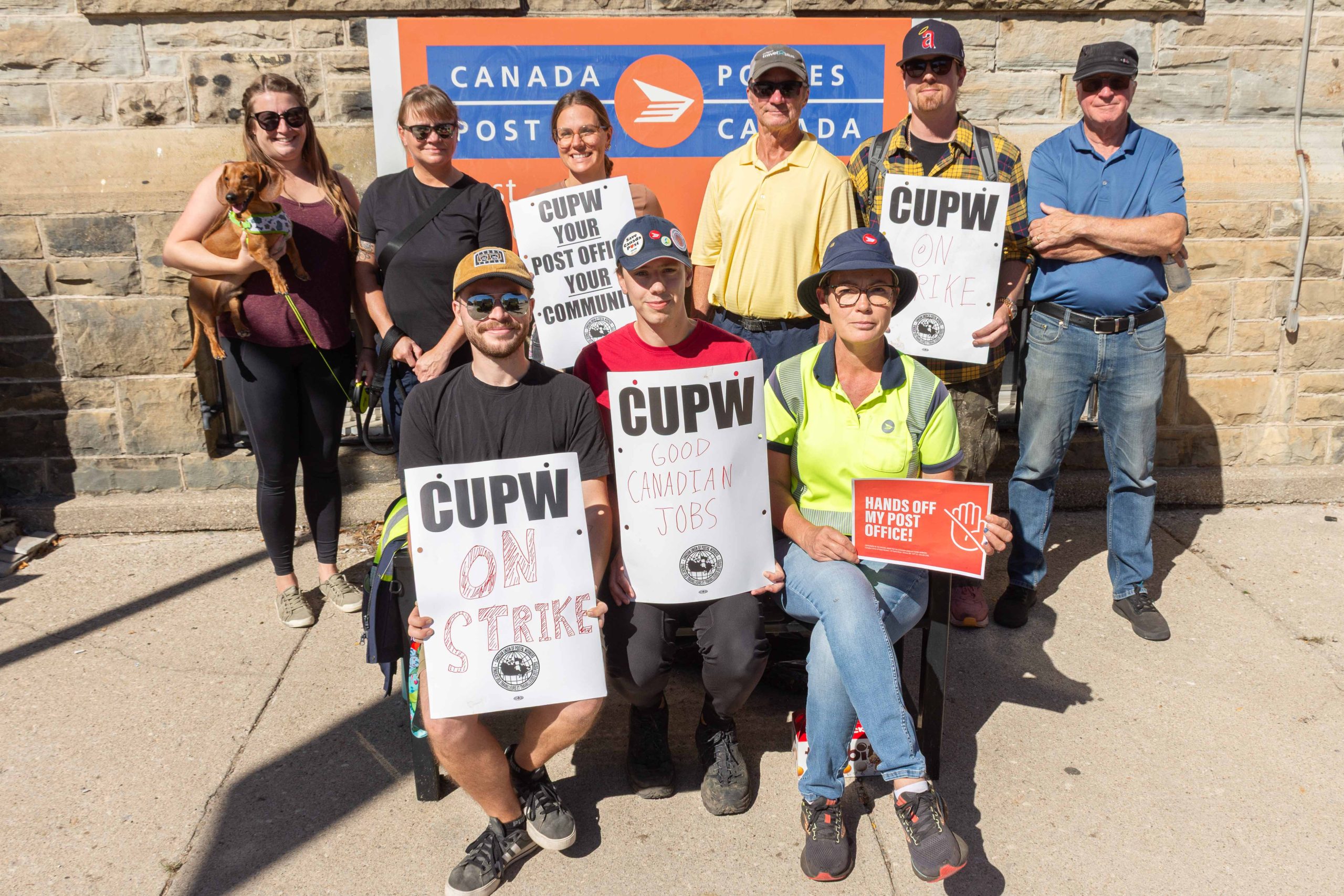
WELLINGTON COUNTY – Mail and parcel deliveries have abruptly stopped across Wellington County after unionized carriers walked off the job on Thursday as part of a nation-wide job action responding to government measures that could cost jobs.
On Friday morning, Fergus post office union steward Connor Ehrlich stood outside the building beside mail carrier Tom Bott as people asked why they couldn’t drop off mail or pick up parcels.
Some drivers honked their horns and waved or gestured with a thumbs-up; one man paused to give the workers the middle finger before driving away.
“I’m kind of upset because I’ve got two cards that I need to mail and I cannot,” said passerby Susan Radojevic, who stopped to talk with Ehrlich and Bott.
At a news conference Thursday, federal transportation, public works and procurement minister Joël Lightbound announced that Canada Post’s door-to-door mail delivery would be eliminated, rural post offices could be closed, and non-urgent mail would no longer be flown.
Canada Post is “effectively insolvent” and facing “an existential crisis,” Lightbound said.
Mail won’t be processed or delivered during the strike and no new items are being accepted.
Local Ontario Works recipients will not receive payments delivered by mail and must arrange for pickup at an Ontario Works office.
Federal social assistance cheques, however, will continue to be delivered, as will shipping of live animals already in the system.
Birthday and Thanksgiving cards, like the ones Radojevic wanted to mail, are unlikely to reach their destinations anytime soon.
She simultaneously lauded Ehrlich and Bott for picketing and challenged their position.
“Right now, everybody’s at extreme ends,” she said. “Do you think that by going on strike, you’re harming your cause?”
Ehrlich said the government’s announcement means “mass layoffs.”
“A lot of us are at risk of losing our jobs no matter what,” Ehrlich responded.
“I see your argument about us hurting our cause, but what else do we have left to do?”
The Canadian Union of Postal Workers called a nation-wide strike for 55,000 members hours after the news conference on Sept. 25, with CUPW national president Jan Simpson saying the changes “could result in major job losses.”
Canada Post said in a statement it is “disappointed that the union chose to escalate their strike activity, which will further deteriorate Canada Posts’ financial situation.”
The latest strike, Canada Post said, will affect “millions of Canadians and businesses across the country.”
Unionized workers previously walked off the job in November 2024, having at that point been without a contract for a year.
CUPW Local 546 president Remegius Cheeke, based in Guelph and representing workers in Wellington County, said the union wanted a contract with wage increases and to stop Canada Post from relying on casual workers.
After five weeks, the Canada Industrial Relations Board ordered a return to work with a retroactive five-per-cent wage increase.
Workers have remained in a strike position since, with Canada Post and CUPW at an impasse on a deal.
Cheeke said “hundreds of workers” are affected locally by latest the strike.
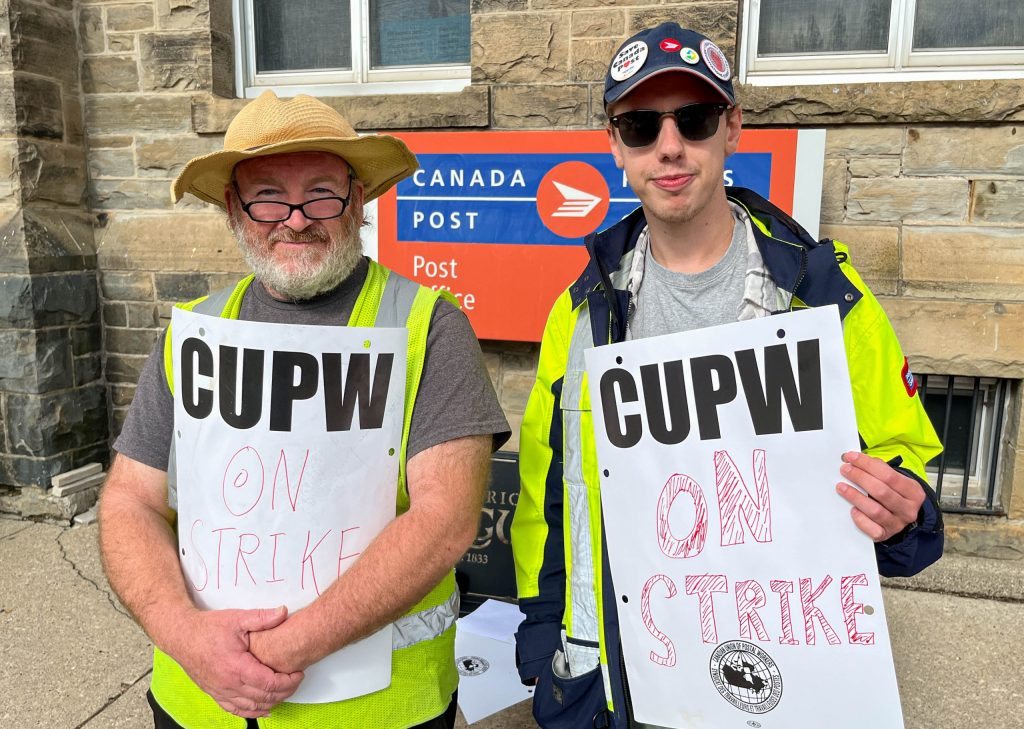
Fergus post office union steward Connor Ehrlich, right, and mail carrier Tom Bott picket outside the post office on Sept. 26. Photo by Jordan Snobelen
At Thursday’s news conference, Lightbound announced around four million addresses still receiving door-to-door mail delivery will be switched over to community mailboxes, a change expected to save $400 million annually.
Canada Post is losing $10 million every day, Lightbound said, and is on track to lose $1.5 billion this year after reporting a second-quarter loss of $407 million. Canada Post reported a $1 billion loss last year.
The federal government provided the postal service with a $1-billion loan this year to keep it running.
Lightbound said the postal service has failed to adapt to declining letter mail and private companies swooping in on parcel deliveries.
“This situation is unsustainable,” he said.
Last year, Canada Post delivered two billion letters, down from 5.5 billion letters in 2006. The average home now receives two letters per week.
The Crown corporation’s share of the parcel delivery market has also declined to less than 24 per cent, down from 62 per cent in 2019.
Meanwhile, Canada’s population has grown, adding “millions more households to deliver mail to each day,” Canada Post said.
“This combination of delivering fewer letters to more addresses has led to increased service costs, declining revenues and mounting financial losses.”
In addition to switching to community mailboxes and rural closures, non-urgent mail will no longer be moved by air, a move Lightbound said will save at least $20 million per year.
“Canada Post must return to the government with a plan to modernize and right-size its network,” Lightbound said.
The changes follow recommendations in a May report from commissioner William Kaplan, who was tasked with examining the Canada Post-CUPW dispute.
Kaplan said the “bankrupt” corporation would continue deteriorating without “thoughtful, measured, staged, but immediate changes.”
Canada Post CEO Doug Ettinger welcomed the changes, saying in a statement the government’s loosening of restrictions on the corporation “will allow us to make the changes needed to restore Canada’s postal service for all Canadians by evolving to better meet their needs.”
“Our goal is to ensure that a strong, affordable, Canadian-made, Canadian-run delivery provider supports the needs of today’s economy and delivers to every community across the country,” Ettinger added.

Advertiser file photo
Nita Chhinzer, an associate professor at University of Guelph’s Gordon S. Lang School of Business and Economics, said the government is coming around to “recognizing the world around them has changed.”
Canada Post previously tried to switch over from door-to-door delivery to community mailboxes in 2015, but the program was ultimately scrapped by the Liberal government.
The government is unable to ignore years of consecutive losses, Chhinzer said, and is now lifting restrictions to give space for reinvention.
“I think that for Canada Post to survive and be a viable business, it needs to reinvent itself and be much more aligned with the market today,” Chhinzer said.
“This is a major period of disruption.”
Chhinzer said the postal service needs to align with customer demands for immediacy in an increasingly online world.
“At some point, there will be either a shift of where and how people work, or there will be a need for people to reconsider their roles at Canada Post,” she said.
“At the end of the day, Canada Post is a service, and services are driven by customer demand.”
Canada Post said it’s reassessing new offers to propose to CUPW following the government’s announcement.
“We remain committed to reaching negotiated agreements with CUPW that are affordable, support our people and help build a sustainable future for the company,” Canada Post said in a statement Friday.
“We have confirmed with CUPW that we are working diligently and will present these new offers as soon as possible.”
Cheeke, the CUPW Local 546 branch president, said Canada Post has “failed to negotiate and waited for the government to intervene at every step and hasn’t negotiated fairly.”
Cheeke said it’s “most likely” the labour dispute will be resolved in binding arbitration.
“Monday will be full-bore picket duty.”
There were nine strikers picketing outside the Fergus post office on the morning of Sept. 29.
No word about an offer from Canada Post had yet been received by the union.