
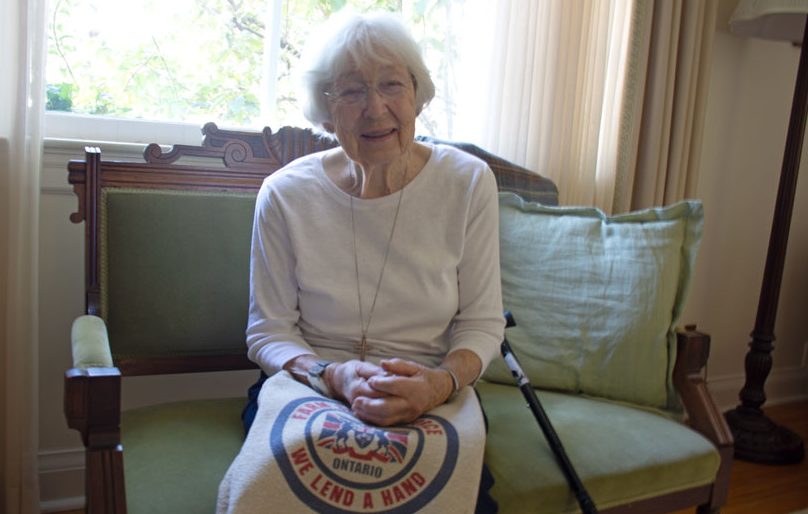
FERGUS – It’s taken 80 years, but Jean Collier has suddenly become an overnight sensation.
Now in her 99th year, the Fergus woman is a sought-after speaker and will be an honoured guest at the screening of the film We Lend a Hand: The Forgotten Story of Ontario Farmerettes at the Alma Community Centre on Sept. 27.
The farmerette program, seemingly long forgotten, has come to light again thanks to the film and a book written by Shirleyan English and Bonnie Sitter called Onion Skins and Peach Fuzz: Memories of Ontario Farmerettes.
The farmerette program started during the Second World War, when men were away at war and women were needed to fill their shoes here at home.
The provincial government started a program for teenaged girls to work on farms and help bring in the harvest.
The Ontario Farm Service Force – farmerettes for short – ran from 1941 to 1952 and employed 40,000 teenage girls in Ontario and Quebec who stepped up to do their part for the war effort.
They lived and worked on farms from April to September, were paid nominal amounts for their labour, and successfully harvested food that was sent to troops and civilians on the front line.
“I was 16, a Grade 11 student at North Toronto Collegiate. I was a city girl,” Collier said in an interview in her Fergus home, where she’s lived for 26 years.
“The government came with this great plea: ‘we need you to bring in the crops.’”
Her father had been a chaplain in the air force and died in 1941.
So, her mother had been a widow for just two years when her daughter asked if she could go and help farmers.
“My mother thought about it for a while and said, ‘That’s a good cause. You can go.’ I really wanted to do my bit,” Collier said.
She was lucky to have a friend come with her, she said, as many farmerettes didn’t know a soul when they reached their destination.
Collier and her friend Ruth were sent to Waterford, Ontario along with 60 other girls.
They were accommodated in the local high school; bunk beds filled the school gym.
They worked eight hours a day and were paid 25 cents an hour, which was the going rate for farm labourers.
They were picked up by their farmers at 8am, transported to the farm and returned to the high school by 6pm for dinner.
From their pay they had to pay $4.50 a week for room and board. The commitment was 13 weeks.
“It was hard work and we suffered blisters and bruises and sunburn. But I loved it,” Collier said.
“I saw the need, so I went back.”
She spent three summers as a farmerette.
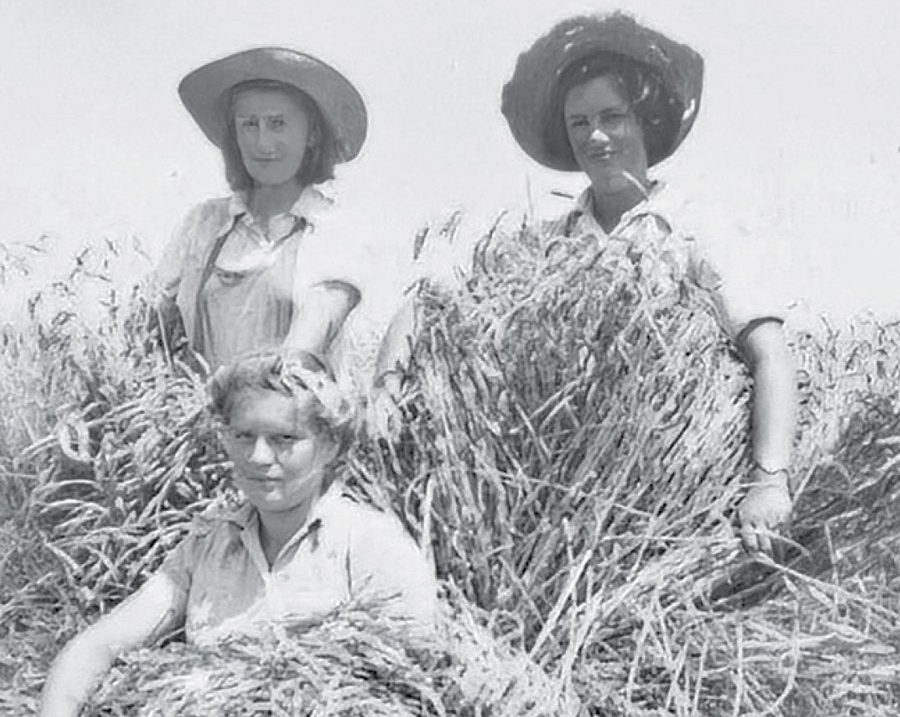
Hard work – Some 40,000 teenaged girls joined the farmerette program to help bring in the harvest during the Second World War.
Submitted photo
In 1943 she was in Waterford; in 1944 she was in St. David’s, where the girls stayed in a converted horse barn; and in 1945 she was in Kingsville where the girls stayed in a vacant casino.
“I didn’t know much about farmers, but they are special people,” she said, recalling how one farmer lost his entire crop of melons due to an early frost.
Most of the girls had never been away from home before, so it was quite an adventure.
They learned how to budget, how to do their own laundry and how to harvest various crops.
They also learned to think for themselves and most came away feeling proud of their contribution to the war effort.
On May 8, 1945, Collier was harvesting peaches when the farmer she was working for came out and told them the war in Europe was over.
“I was so happy for my brother (who was a soldier in the war). I almost fell out of the tree,” she said, laughing at the memory.
Bonnie Sitter
Bonnie Sitter was not a farmerette, but she did write a book about them and that played a major part in getting the documentary made.
“It started with a tiny picture, two inches by two and a half inches,” she said in a phone interview.
It was a photo she found in her husband’s photo album after he had died of “three girls sitting on the running board of a car and on the back, it said ‘Farmerettes, 1946.’”
Sitter did some research and discovered her father-in-law, a farmer, had hired some farmerettes back in the day.
She had never heard of the program.
“I felt indignant that it wasn’t taught to me at school. I decided I would do some research and learn more,” she said.
She wrote an article about the farmerettes for The Rural Voice magazine and out of the blue was contacted by Shirleyan English, who, it turned out, was a farmerette at Sitter’s father-in-law’s farm in 1952.
Together they conducted more interviews and eventually completed the book.
While each farmerette had her own experience, collectively they shared the bond of a common experience.
“They did so much growing up,” Sitter said. “It was a big learning experience for each and every one of them. They didn’t want to fail.”
Sitter said people were skeptical when the program was first announced.
“People didn’t think it would work. But it did work. It was a well-thought-out system,” she said.
“And many girls went back and encouraged their sisters to join as well.”
Thanks to the opportunity to be independent, many went on to become professionals – nurses, teachers, engineers – while others realized they loved the farm life and married farmers.
English and Sitter’s book, Onion Skins and Peach Fuzz: Memories of Ontario Farmerettes, was self-published in 2019 and it was adapted into a play in 2020 by Toronto playwright and actor Alison Lawrence.
The pandemic meant the play couldn’t be staged for a few years. In the meantime, Sitter met Colin Field, who decided he wanted to make a documentary.
That’s been its own journey, Sitter said with understatement, but the film is complete and has been touring southern Ontario.
Field, the producer, has rented the Hot Docs Ted Rogers Cinema on Bloor Street in Toronto to screen the documentary on Remembrance Day and tickets are available on the website welendahand.ca.
Though she is not featured in the book or the film, 80 years after her experience as a farmerette, Collier has attended many of the screenings, speaking about her experience before the film begins.
She paused in thought when asked how being a farmerette impacted her.
“I learned if there’s a need, you should answer that need,” she said.
“It made me aware of what goes on to get food on the table. It made me understand the hardships for farmers and it gave me an understanding about money. It made me independent.”
But it was also fun, she said.
“There was such a camaraderie. We did have fun. And I learned to love the land. As a city girl I never would have known any of that.”
She added, “There was a need and we responded. Farmers could not have brought in those crops without the 40,000 farmerettes and I’m proud to be one.
“The biggest thing was my friendship with Ruth. We became life-long bosom buddies. We could talk about the strawberry patch and we both knew what we meant.
“The farmerettes shaped me for the future and I wouldn’t have missed it for the world.”
The Wellington County Historical Society is bringing the documentary We Lend a Hand: The Forgotten Story of Ontario Farmerettes to the Alma Community Centre on Sept. 27 at 2pm.
Field, Sitter, Senator Rob Black, Collier and other farmerettes will be there for a Q&A after the screening.
Tickets are $20 and available on Eventbrite.