

KENILWORTH – New pig barns on two different farms will be built closer to their neighbours than is normally allowed.
The proposed locations for each barn do not meet the minimum distance separation (MDS) from the nearest dwellings, a setback required by the Ontario Ministry of Agriculture Food and Agribusiness.
Municipal councils can provide relief from MDS setbacks in certain circumstances, and minor variances were approved to permit the two barns during a Wellington North public meeting on June 2.
Notices about the public meeting were posted on each farm on May 13, and mailed sent out to property owners within 60 metres and applicable agencies.
No members of the public offered input on either application.
Wellington North planner Asavari Jadhav-Admane said township staff have no concerns with the relief requested for either new barn and noted both applications maintain the general intent and purpose of the official plan and zoning bylaws and are minor, desirable and appropriate for the development of the properties.
Both farm properties are designated prime agriculture by Wellington County and zoned agriculture by the township, and the proposed barns meet all other requirements of the zoning bylaws.
Riverstown-area pig farm
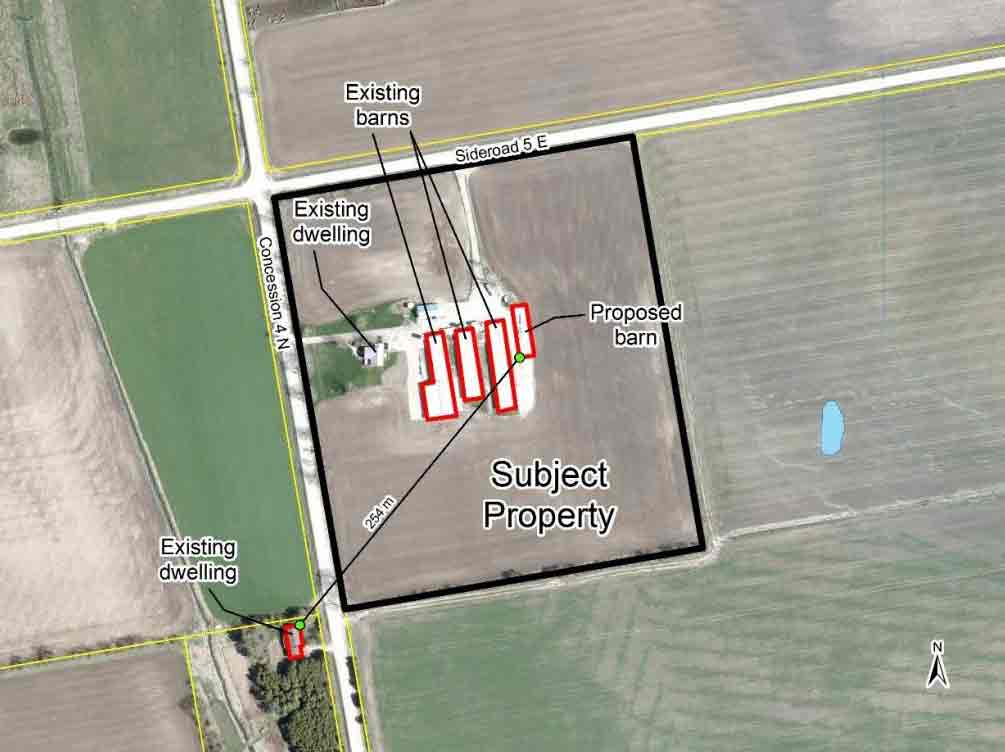
One of the pig barns will be built at 9275 Concession 4 N., an eight hectare (20 acre) farm northeast of Riverstown.
There are already three barns on the property, as well as a house and a shed, and the owners are set to build a fourth barn beside the others.
This barn is proposed to be 254 metres (833 feet) from the nearest neighbouring dwelling, at 9250 Concession 4 N., whereas OMAFA typically requires a MDS setback of 288 metres (945 feet).
“The location of the new barn provides operational efficiency and limits impact to the crop production,” Jadhav-Admane stated in a letter to Wellington North chief building official Darren Jones.
“The new barn is proposed to be located on the east side of the existing buildings, which is furthest from the neighbouring house,” Jadhav-Admane continues.
“In order to meet the calculated setback requirement, the new barn would have to be constructed further north and east by 34m (113ft) which would have placed the building in the crop field and take additional land out of production which is not ideal.”
Councillor Penny Renken said she doesn’t see a problem with the application because “The proposed barn is on the furthest side away from the main dwelling.
“And all the other barns, it seems to me, have a lesser amount of setback than the one that is being proposed. And it’s within the confines of the other barns.”
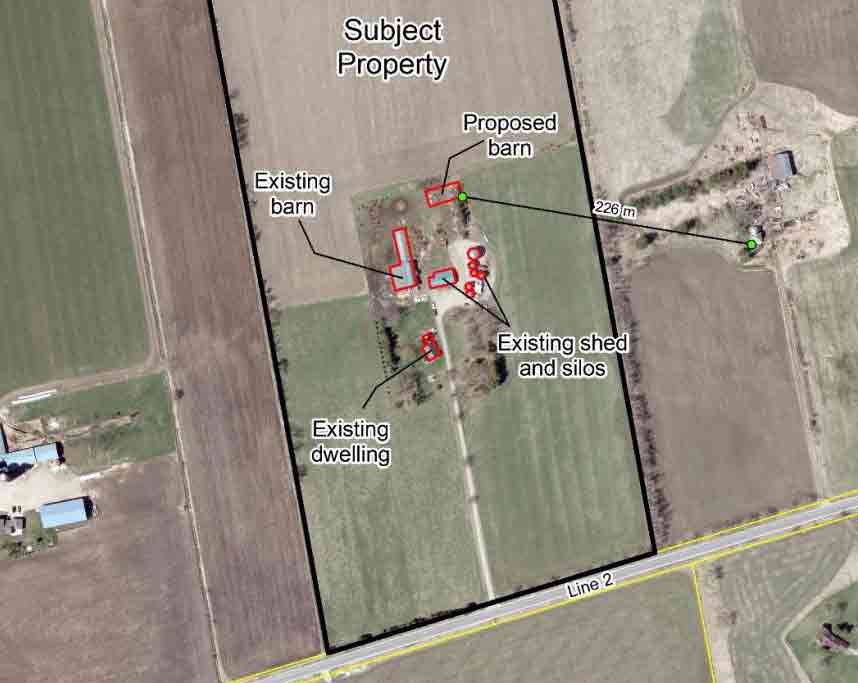
Pig barns – Minor variances were approved to permit two pig barns near Arthur.
Images from Wellington North agenda package
Arthur-area pig farm
The owners of 8430 Line 2, northeast of Arthur, are set to construct a pig barn near an existing barn on their property.
There are also existing silos, a house and a shed on the farm.
The new barn is proposed to be 226 metres from the nearest neighbouring residence, at 8448 Line 2, whereas OMAFA requires an MDS setback of 348 metres (1,142 feet).
The neighbouring residence is condemned and not habitable, but MDS guidelines still apply to condemned houses, Jones said during the meeting.
“The location of the new barn provides operational efficiency and limits impacts to the crop production and tile drainage,” stated Jadhav-Admane in a letter to Jones.
“Planning staff note that even if the barn was shifted further west to be within the building cluster the setbacks would not appear to be met.
“Shifting the building further westward may impact the existing yard for the cattle as well.”
Councillor Sherry Burke asked property owner Scott Lennox if he would consider building the barn further west.
Lennox said he could consider doing so, but that would increase the project cost significantly.
The Wellington Federation of Agriculture did suggest a location further west for the barn, but Jones and councillor Steve McCabe said that location would be on prime agricultural land and closer to an occupied house.
Councillor Lisa Hern asked what would happen if the condemned house was bulldozed and someone wanted to erect a new house.
“They would apply for a building permit and we’d do MDS calculations,” Jones said, noting there appears to be room on the farm for a house to be built in compliance with MDS setbacks.
McCabe said, “I don’t want to make speculations on future possibilities with this house being condemned and something else being built down the road … I’d prefer to deal with what we have here and now.
“And it sounds like there is room for a new building if someone was to buy it and build a new house on the existing property,” he said.
“So I think we have to deal with what we have in front of us and then go from there and make a decision.”
Burke said she agrees with McCabe and asked if the new barn would “constrict any future agricultural uses in the neighbourhood.”
“There’s no MDS setback from agricultural buildings to agricultural buildings,” Jones said. “So the only thing it should restrict is the location of a new dwelling on the neighbouring property.”
Hern asked if it’s possible to renovate a condemned house to make it habitable.
“Yes, that is possible and these property owners were notified – a notice was circulated and any new property purchaser would either get a copy of that notice in their package or they’d be aware that there was a new barn on the neighbouring property,” Jones said.
Hern suggested council include a requirement that the applicant plant trees between the two properties “to try to assist with some of that conflict.
“The reason that we have MDS clearly is to eliminate conflict and anyone that’s had a bad neighbour will understand why some of this can be pretty necessary. And this is a pretty big variance,” Hern continued.
“I don’t want to set people up to argue down the road.”
So council added a condition to the variance that the treeline on the eastern boundary be extended an additional 65 metres with tree seedlings – something the applicant said he is fine with.