


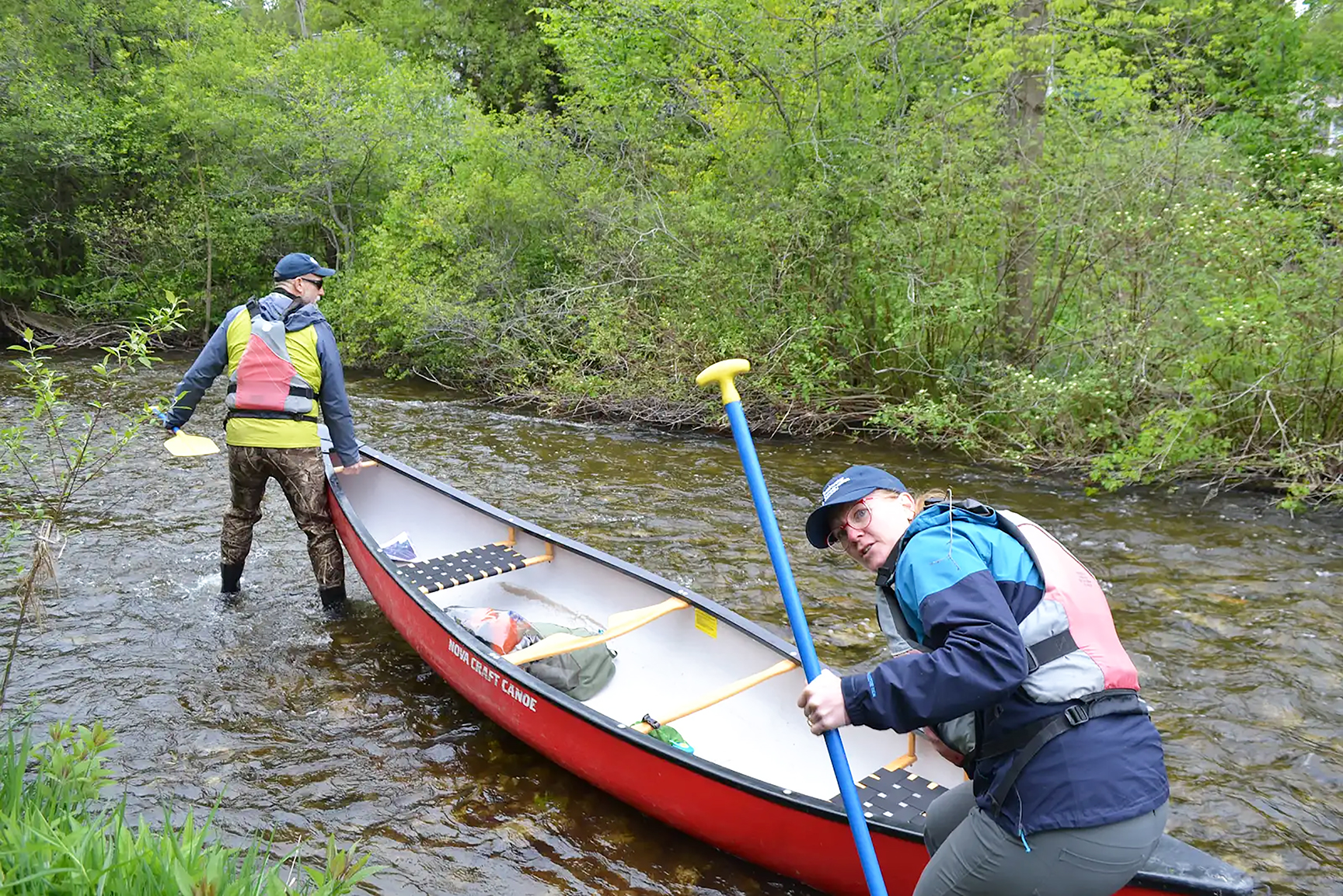
GUELPH-ERAMOSA – Staff and volunteers from Freshwater Conservation Canada (FCC) took to the Eramosa River in canoes in an attempt to catch invasive species before they spread.
FCC is a not-for-profit corporation focused on conserving and restoring freshwater ecosystems.
Eight people from FCC embarked together the morning of May 31 on a four-hour journey.
They traveled along the Eramosa River in canoes from Eden Mills to McQuillan’s Bridge in Guelph, looking for new signs of invasive species such as giant hogweed, flowering rush and phragmites.
FCC program manager David Fields said the invasive species not only threaten the strength of the native ecosystem, but can also be a risk to public safety and the economy.
“If people are exposed to the sap of giant hogweed, then that sap is exposed to sunlight, it can cause severe burns,” said Fields in an interview prior to the canoe survey.
For invasive species such as phragmites, Fields said managing the plant becomes more costly when it has been left to spread and establish. Phragmites can also clog drains, affecting agriculture in the area and causing flooding.
Fields explained that while giant hogweed is widespread in the Grand River, it has only more recently begun to appear in the Eramosa and Speed Rivers.
He wants to catch it before it’s too late.
“The earlier we get in there, the easier it is to manage, the more effective we can be,” said Fields.
After the canoe survey, FCC director Lesley Peterson reported four new clusters of giant hogweed along the Eramosa River.
The group is planning its next steps, but combatting these invasive species isn’t as simple as yanking the plant out of the ground.
Once it finds an invasive species, FCC contacts the landowner and works with them on a solution. This could include connecting them with another agency such as the municipality or county, or depending on the scale, FCC could manage it alone.
Fields mentioned FCC members had already been on the Eramosa River earlier this spring combatting the invasions of giant hogweed.
Fields also emphasized how keeping the ecosystems along rivers healthy and diverse can aid when addressing climate change.
“These areas are very important,” he said.
“Not only for sequestering carbon out of the atmosphere, but also for private shade, including areas which can be enjoyable when you’re walking through them.
“But actually our municipalities, our cities and towns rely on these areas to keep cool as we’re facing rising temperatures.”