

Trash or treasure? Maybe museum and archives can decide
Local museum likes artifacts that are unique, local, and that come with a story


ABOYNE – More than the artifacts themselves, the Wellington County Museum and Archives loves to receive local artifacts that come with a story or that help to piece together the larger story of the people and places in the county’s history.
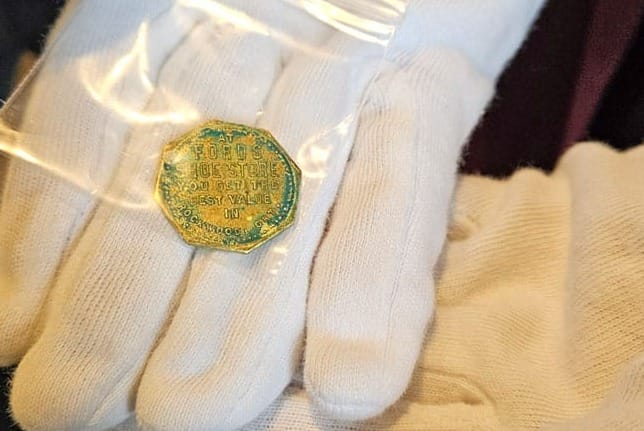
The shoe store token local resident Eric Huber dropped off on March 11 fit the bill.
It is old, circa 1911, local, from Ford’s Shoe Store in Rockwood, and it’s got a really interesting back story, said museum curator Hailey Johnston.
Archivists were able to find a short history of Eli Ford, who lived in Eden Mills and perhaps Rockwood and was listed as a merchant in Rockwood in 1911.
He gave tokens to his regular customers, each good for five cents off their next cash purchase of shoes.
This token is octagonal in shape, made of brass and is 23mm in diameter.
The information about Ford comes from a book called Numismatically Wellington, a numismatic listing of various businesses in Wellington County and the token or medals they used. It was written by Harry N. James and published in May 2015.
The book also has information about Ford’s parents, Eli Ford and Josephine (Brohman) Ford, who came to Canada from England in 1851 and settled in the Guelph area. They had 11 children in all, some born in England and some in Canada.
The younger Eli Ford married Mary Catherine Ingle in 1891. Eli was already a shoemaker at this time.
Museum curator Hailey Johnston said these tokens were used the way current shop owners use coupons, offering a deal to loyal and returning customers.
“We see a lot of them,” she said, noting bread and milk tokens were fairly common back in the day.
The shoe store token is less common and the fact it’s from a store in Rockwood made the museum interested in acquiring it.
“We can’t take everything though,” Johnston said, adding the museum doesn’t have an acquisition budget, nor does it have unlimited space. But as a registered charity it can issue tax receipts, so there’s some benefit to those who donate items.
“The hardest part of my job is deciding what to keep,” said Johnston.
Huber, who has a side hustle clearing junk and delivering items to local charities, often spies items that might have historical interest and is a regular donor to the museum.
“He’s got an eye for things,” Johnston said.
Huber said he has an interest in historical items and often haunts antique stores, thrift stores and flea markets. That’s where he found the shoe store token.
Johnston said she’s happy to talk to people to discern whether their item might be accepted by the museum.
“We love people to offer us things and if I can’t say yes, I try to make suggestions on where (their item) can go,” she said.
Archivist Karen Wagner is also interested in acquiring items for her end of the facility, such as log books and business records.
The focus is on local (from Wellington County) historic items that tell a story. So the more information about an item the better.
“It’s not necessarily the thing they think we’ll be interested in that we take,” Johnston added. “It’s really about the story behind it.”
Anyone with artifacts they think the museum and archives would be interested in can contact Johnston at 519-846-0916 x5226 or email haileyj@wellington.ca.
Anyone with archival records can contact Karen Wagner at ext. 5235 or email karenw@wellington.ca.


