

They took to the street to ‘take back the night’


GUELPH – Make no mistake, Canada has a legal system, not a justice system, especially when it comes to gender-based violence, officials with Guelph-Wellington Women in Crisis say (GWWIC).
The number of people who report cases of sexual abuse are miniscule compared to actual numbers, they note – and the number of convictions against abusers is even smaller.
And the number of times victims who go to court feel justice was served is practically zero, said Cindy McMann, public educator for GWWIC, which hosted the annual Take Back the Night rally in Guelph on Sept. 18.
Take Back the Night is a global movement against sexual violence.
One night each year, hundreds of cities around the world take to the streets through marches, rallies and protests in an effort to make communities safer for women and gender-diverse people.
The theme of the event in Guelph this year was “reimagine justice” and McMann fired up the crowd when she referred to the not guilty verdict in the case of five former Canadian World Junior hockey players charged with sexual assaulting a victim known only as E.M.
“I heard from a lot of people that they felt the justice system is broken” after the verdict, McMann said.
“And I annoyed several of them by insisting that it is in fact not broken at all. It’s working exactly as it is intended to do.
“For me, that retro verdict was more an illustration of how desperately we need to reimagine what justice could look like.”
Dr. Marsha Myrie Obi, a professor of Black organizing and resistance at the University of Guelph, was the guest speaker and she talked about colonialism, how colonialism is embedded in the courts, and why there needs to be a different approach to cases of gender-based violence.
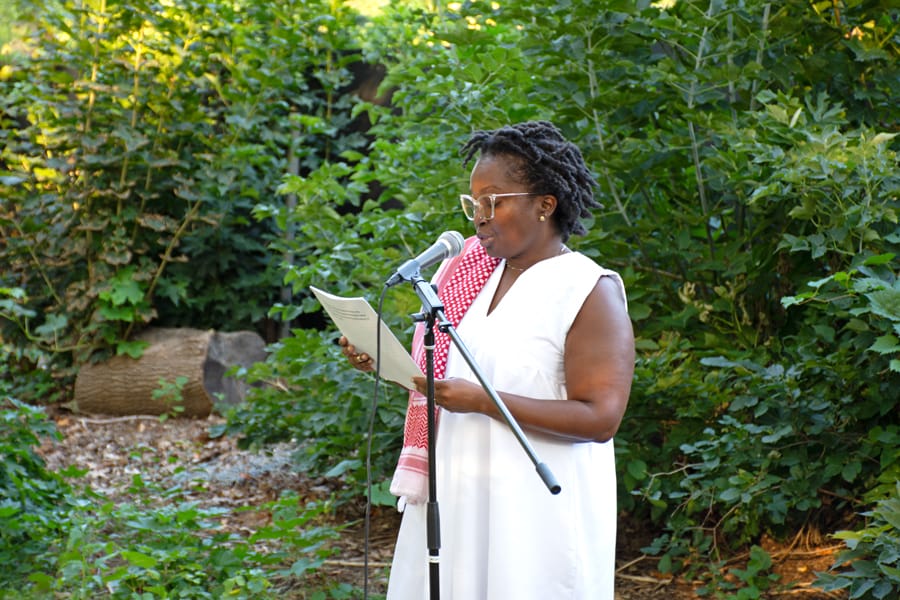
She said what victims of violence need is health care, emotional support and a legal system that recognizes and understands that victims often can’t remember every detail of trauma.
“Courts ignore the emotional harm of gender-based violence, and at its core, gender-based violence is a soul injury,” she said.
“At its worst, it steals the lives of survivors, their families and their communities.”
McMann said victims who go to court often feel revictimized, unbelieved, belittled and deflated by the system. Some victims have called court worse than the assault.
“Our legal processes were created in olden times when nobody knew anything about trauma,” she said, calling the legal system “a trap.”
“It (the legal system) needs our word to be able to convict people who cause us harm, but our word is always already considered untrustworthy.
"It always already doesn’t believe us. And it’s happy to retraumatize us to prove it.”
There’s a motion afoot to allow community justice programs to use restorative justice options rather than trials, court and possibly prison sentences.
“We need options for those folks who can’t meaningfully access the criminal legal system or have an adversarial relationship to it, who understand that it is unlikely to help them or who don’t feel like what it has to offer is interesting or useful for them,” McMann said.
“And if our systems aren’t going to stand up for survivors, we can speak up ourselves.
“We can be very loud about our support for survivors. Let’s go be loud.”
About 100 attendees – including men, women, children and dogs – then got loud, marching through downtown Guelph chanting “survivors unite, take back the night” and “what do we want? Justice. When do we want it? Now.”
“I think the reason I come is for the unity, the sisterhood, and the support,” said Cleo Brown, a local resident who has come to three or four of the Take Back the Night events.
“Just getting through the day can be a huge battle, never mind getting through court.
“I take courage knowing this kind of support is out there.”


