


Speakers aim to empower kids at Elora Empowerment Day
Patrick Anderson, Brian Williams shared stories with county students on April 22

ELORA – “Kindness matters.”
That’s the theme of this year’s Empowerment Series for students in Grades 6 through 8 at Upper Grand District School Board schools.
The Empowerment tradition kicked off in 2014, when Drayton kids organized an event for 1,300 students at Drayton’s PMD Arena, with help from teacher Andy Speers.
Last year, the event saw more than 5,000 students gather at the Sleeman Centre in Guelph to hear from five motivational speakers, including Christine Sinclair.
But this year, Speers switched things up, as he felt the empowerment message could be more impactful spread across four intimate events.
So he launched the Empowerment Series, with an event in Drayton on March 5, Elora on April 22, Guelph on April 23 and Dufferin on May 5.
Kids from Elora, JD Hogarth, Grand River, Alma, Ponsonby, Salem, John Black and Rockwood public schools gathered at Elora Public School with guest speakers Patrick Anderson and Brian Williams.
The event was sponsored by Skyline and local Optimist Clubs, which have supported Empowerment Day for 11 years.
Brian Williams
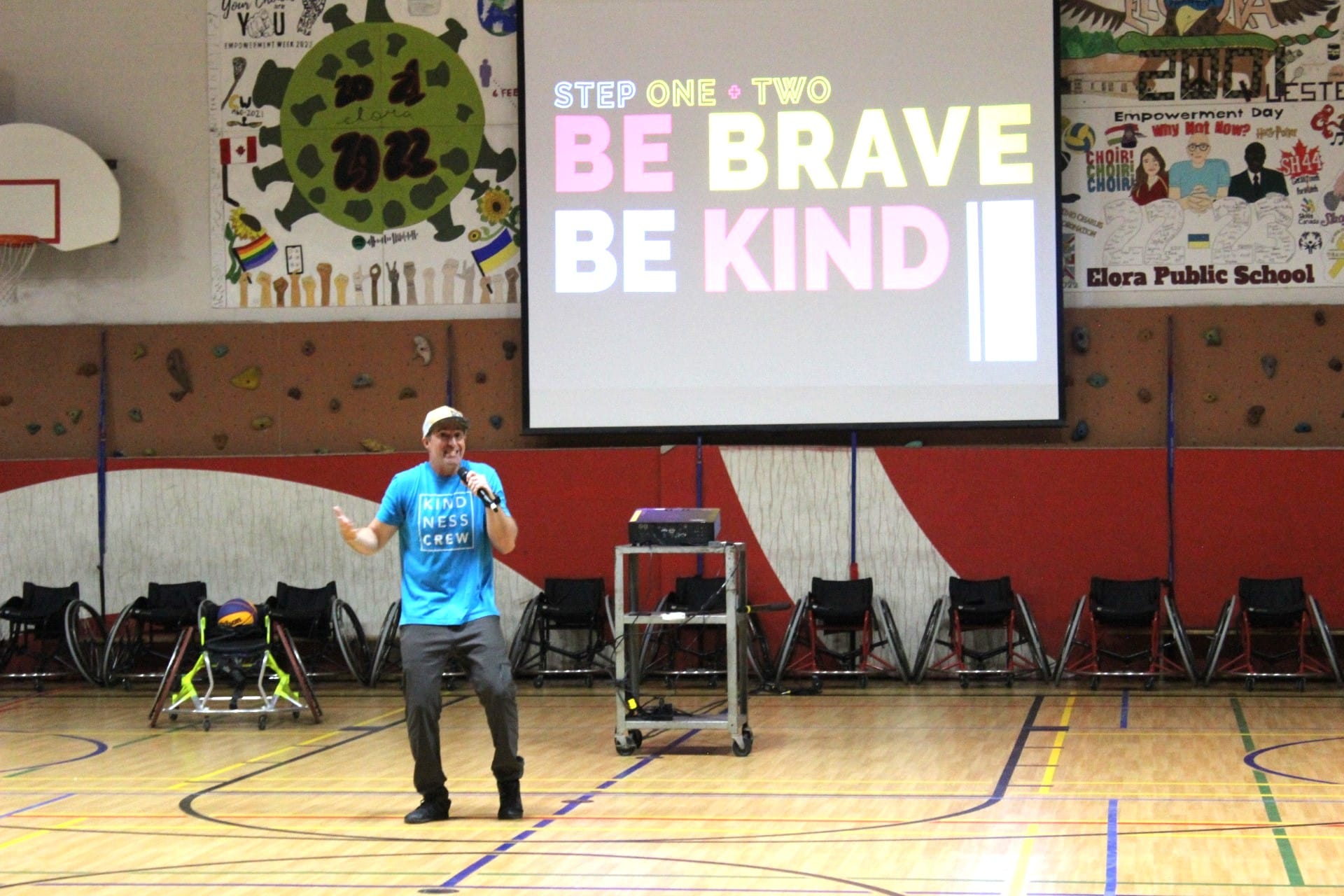
Williams, known as “Kindness Ninja,” kicked things off by encouraging everyone to point to the person beside them and say: “You’re awesome.”
His presentation focused on perspective and choosing to see the good in people - both online and in the world.
“Everyone is good at something,” Williams said, and “the thing you’re good at might be what changes the world.”
He told students about his college project, where he worked with youth to collect 8,000 pairs of shoes (in just 15 days) to bring to people in Kenya.
Williams said these shoes helped children in Kibera, Nairobi attend school, because public education there is free but kids must have uniforms, book bags, writing utensils and shoes to attend.
He described a nine-year-old girl putting on shoes for the first time, and then attending her first day of school the next day.
And a teenager named Peter was wearing shoes from Williams when he ran a mile in less than four minutes, a feat that automatically landed him a spot on Kenya’s Olympic track team.
Peter had those lucky shoes in hand when he attended the Beijing Olympics in 2008, Williams said, and he’s currently in Ghana, showing kids those shoes and encouraging them to never give up on their dreams.
Patrick Anderson
Anderson began by reflecting on a moment in his childhood.
He was sitting on a red swingset in his Fergus backyard, praying for his legs, amputated after he was hit by a drunk driver at nine years old, to grow back.
“I was desperate,” Anderson said.
He was tired of watching his friends play hockey and not being able to join in; tired of chasing after them and not being able to catch up; tired of watching them do things he couldn’t do.
Anderson described the moment he woke up in hospital, pulled back the covers, and saw the empty space where his legs used to be.
He turned 10 a few days later, and said he was given heaps of gifts – a Nintendo, a Walkman and loads of Batman gear.
But the gifts didn’t numb the pain of watching people walk down the hallway and thinking he’d never walk that way again.
What gave Anderson his first spark of hope was a visit from another amputee – a man who’d lost both arms and legs and become a Paralympic athlete. Anderson most remembers the calm expression on his face.
“It was the first time I looked at somebody like me and thought ‘maybe there is hope,’” he said.
But the real “miracle moment” came the first time he played wheelchair basketball. It felt good, Anderson said, and before long he was “hooked.”
That wasn’t the end of his struggles, though, and even as he found success in basketball, he “would have traded it in a second for legs."
He got prosthetic legs and with time and patience, was back on two feet.
But the prosthetics were uncomfortable and didn’t work well – he could walk, but he wanted to ice skate, climb trees, jump off things and play sports. The prosthetics couldn’t give him that.
Throughout middle school Anderson pushed through the pain the prosthetics caused him and wore them near-constantly – always hidden beneath pants, except when he was at home with family or out on the basketball court.
Until one day he wore his prosthetics on the court, and his coach Jeff said while wearing the legs was up to Anderson, they were going to slow him down.
That moment helped him reassess how he saw himself – “not an injured hockey player, a perfectly healthy basketball player."
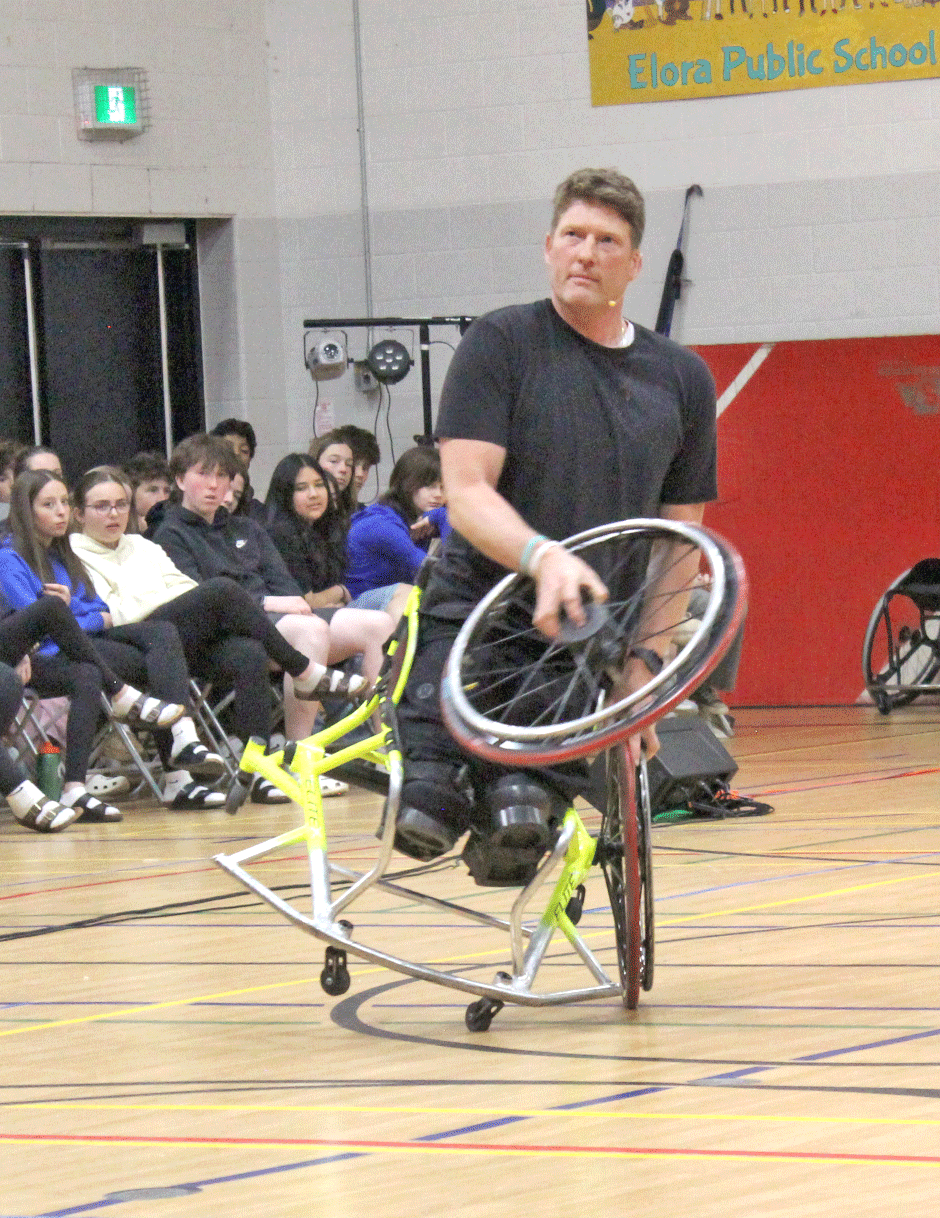
“I stopped looking back at what I’d lost and started appreciating the opportunity to move forward,” he said.
Anderson played on Canada’s national wheelchair basketball team from 1997 to 2024, winning three Olympic gold medals and one silver.
According to the Canadian Paralympic Committee, Anderson is “often hailed as one of the greatest wheelchair basketball players in history.”
He showed the students most of his medals on Empowerment Day, but not the 2004 gold medal from Athens. That one he gave to the team’s coach.
Coaches don’t receive medals, he said, which he thought “didn’t seem right – he was the one that really drove us and pushed us to achieve that medal of excellence.”
Anderson also attributes some of his success to the kindness he receives from the community, beginning with the outpouring of support when he lost his legs and continuing to this day.
People are quick to run to open doors for him and even offer discounts, he said.
But he stressed the importance of also extending that kindness to people without visible scars.
Anderson was with his friend Chris the day he was hit by a drunk driver, and though Chris doesn’t bear the same physical scars, Anderson said “his scars are still just as painful.
“It’s easy to lead with kindness if someone is cute, or in a wheelchair, or smiling – it’s much harder if they have a grumpy face,” he said, but extending kindness when it’s hard is a powerful thing.


