

Guelph high school hosts veterans panel for 23rd year
Eight veterans share stories and wisdom to Our Lady of Lourdes students


GUELPH – “It’s so important for you to see a veteran firsthand. It’s something you can’t get from a textbook.”
That was the message Joe Tersigni had for students at the 23rd edition of a veterans panel at Our Lady of Lourdes Catholic High School on Nov. 6.
A school board trustee and former history department head at the school, Tersigni was the founder of the event and served as emcee for its latest iteration.
“Our veterans paid a price for freedom and they’ll tell you freedom’s not free,” he said prior to introducing a panel of eight veterans.
Grade 12 students Karlee Hemstree and Laila Kwofie said they appreciated the opportunity to listen to the panel.
“I’m grateful our school hosts this every year,” Hemstree said. “One day we won’t be able to have this firsthand experience.”
She added the annual event has become a favourite for her, as, “We get to live the lives we do because of them.”
Kwofie said she feels a sense of pride, as the veterans “didn’t have to sacrifice their time or energy ... but they sacrificed it to help and better our country.”
She added it’s important to recognize the veterans who “built up our country.”
Private Elaine Burnett Pettigrew began her service in the 1960s at 16.
“I am here to represent the Canadian Women’s Army Corps (CWAC), who are the support team for the soldiers going into action,” she said.
During her speech Pettigrew explained women were once not allowed in combat and were recruited for many “non-combatant” roles such as radar operators, communication, decoding, intelligence, vehicle maintenance, medical teams and ambulance drivers.
“Altogether, there are 55 military trades for women,” she added.
Pettigrew issued uniforms and equipment and completed payroll during her time in the corps.
“I joined the 11th Field Regiment in the early 60s and did the same basic training as the men but I was not allowed in the field with the artillery,” she said.
Members of the CWAC and other services “were pioneers for female soldiers in the Canadian Armed Forces,” Pettigrew said. “Today, there is full equality in leadership and combat roles.”
“Women can now fly planes, command ships and are allowed in the field with combat units alongside male counterparts,” she said.
Sgt. David Noonan is a former U.S. Marine and Vietnam War veteran who began serving at 18.
“I would like you to consider joining the military when the time comes,” he told students. “I know you’re very young right now, but trust me, so was I.”
Noonan said students don’t need to hear about “blood and guts,” although “there was a certain amount of that.”
Instead, he focused on the military “family” he found while serving.
“These guys that I see every year, we were all together in a place called Firebase Neville and we were overrun by enemy soldiers,” Noonan said. “We lost about 20 of our members, but we did beat them back and we did survive.”
Shortly after the attack, he traveled to a village to work with Vietnamese troops.
“There’s a lot of good memories and a lot of sad memories,” Noonan said.
He then asked students if they ever wondered why a two-minute moment of silence occurs on Remembrance Day.
“One [minute] is for those that passed away, and ones [for those] that had to survive,” Noonan said. “Surviving combat is not always rewarding, sometimes you carry it through the rest of your life.
“In fact, I suffer from PTSD (post-traumatic stress disorder) because of that.”
PTSD is a psychological response to the experience of intense traumatic events, particularly those that threaten life. According to Veterans Affairs Canada, in the American Civil War it was referred to as “soldier’s heart;” in the First World War, it was called “shell shock” and in the Second World War, it was known as “war neurosis.”
But despite its effects on him, Noonan said he would serve again “in a heartbeat.”
Rifleman Jacques De Winter was a UN peacekeeper in Cyprus. He joined at 19 as a member of the First Battalion of The Queen’s Own Rifles of Canada in March 1965.
He landed in Cyprus relieving the Canadians Guards regiment for a six-month deployment. De Winter noted his job was to keep “the Turkish people and the Greeks from killing each other.”
He said he did not want to speak about his deployment, but rather bring awareness to the recent loss of four Canadian Armed Forces members during a fire-related training incident at CFB Wainwright in Alberta on Oct. 17.
“I remember the area well because I trained over there twice,” De Winter said. “Keeping this catastrophic accident in mind, I would like to recite a poem.”
He then recited Just A Common Soldier (A Soldier Died Today) by A. Lawrence Vaincourt.
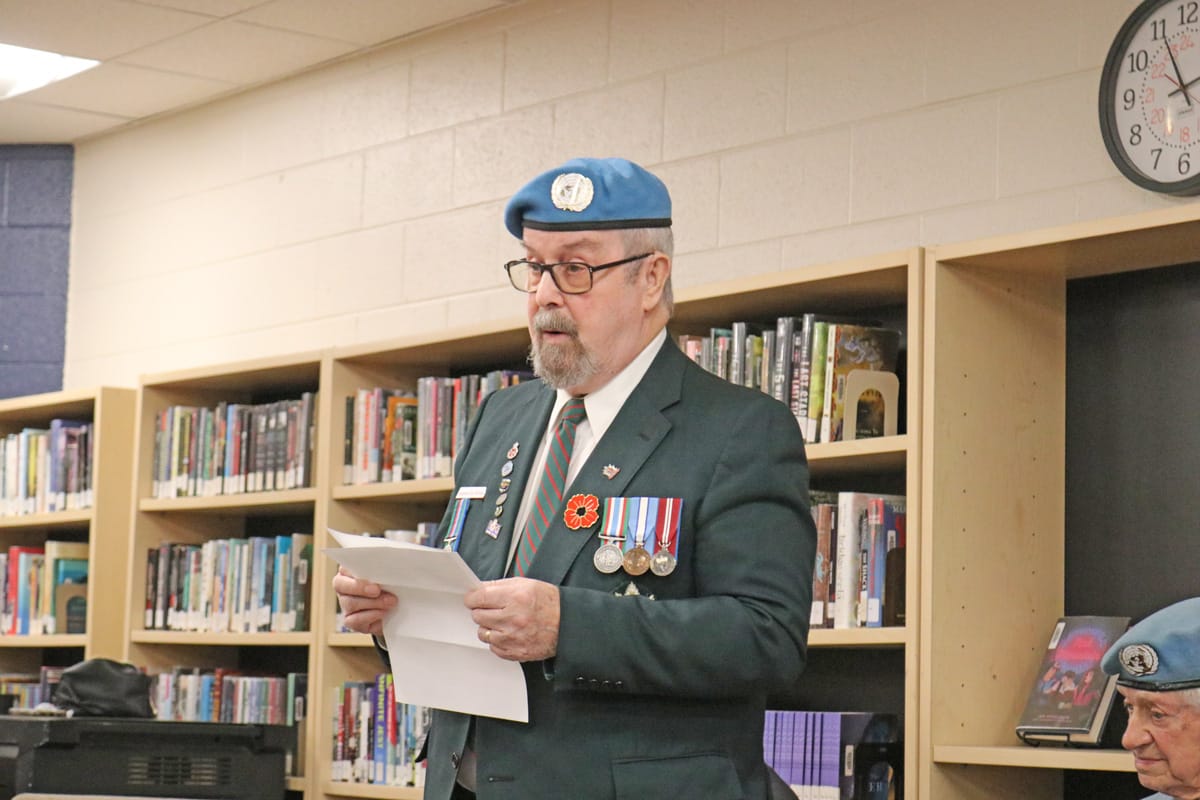
Sgt. Michael Seitz served in the UN Airforce and was a peacekeeper in Egypt in 1966.
Seitz also mentioned serving in the mountainous region of Kashmir in northern India and in Gaza.
“I spent a lot of time in Gaza and that conflict has been going on since 1948,” he said. “We tried to do what we could but the politicians of the world don’t seem to be interested in solving it.”
He added, “It’s going to be up to others with a goal in mind that peace is something all people are entitled to.
“You are the people that can possibly do it,” Seitz told the students.
Bandsman Chuck Merry served in the Royal Canadian Ordnance Corps in WWII in the 11th Field Artillery Regiment.
He joined at 17 and is now 99 years old.
“Yes, I’ve been through it all,” Merry said. “When I was 17 the war was on so I volunteered in order to get into it.”
But because he wasn’t yet 18 years old, Merry wasn’t allowed overseas.
“I did my part to try to help … [and] there were still a lot of people who needed help,” he said. “I’m glad I was able to do my part.”
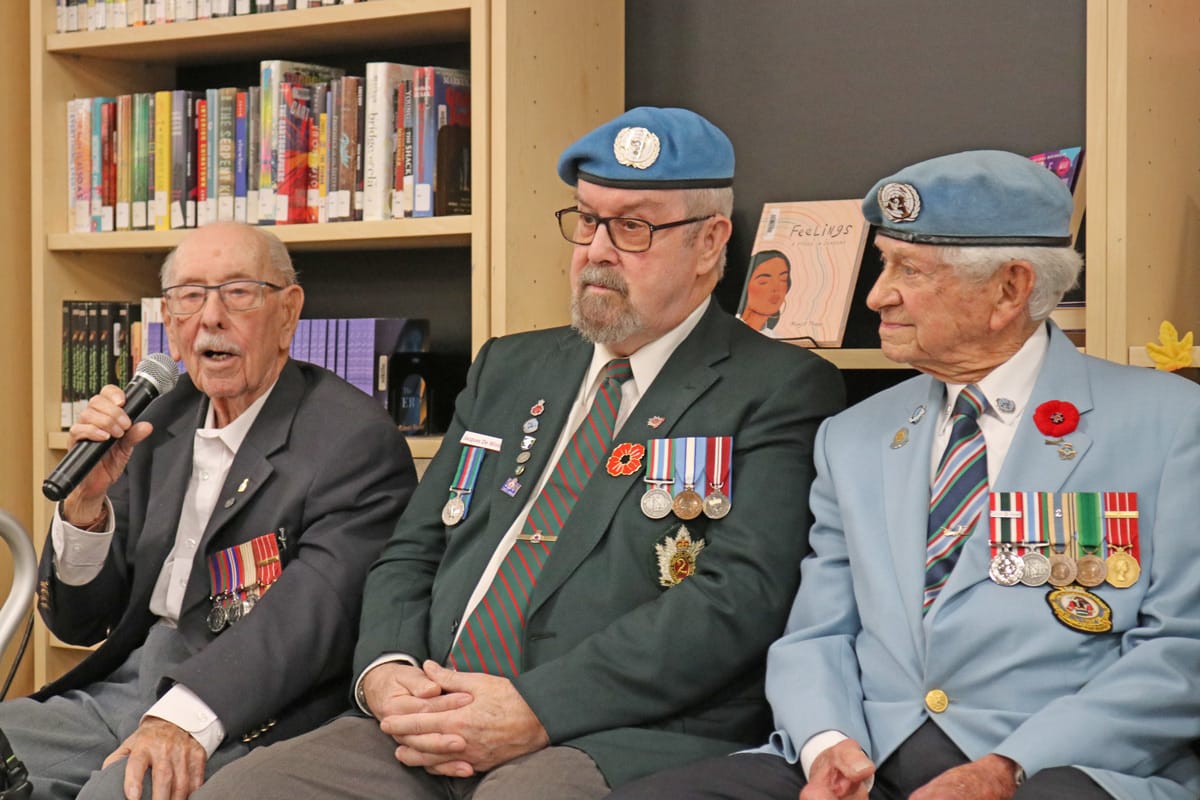
Sgt. Evan Shields served in the Canadian Army as an artillery gunner in the 11th Field Regiment in Afghanistan.
“I joined the army at 17,” he said adding he needed his mother’s permission as he was underage.
At 20 years old, Shields took his father out for breakfast “and I said ‘I’m going to sign up to go to Afghanistan’.”
“We took incoming rocket fire constantly,” Shields told the students. “The Taliban ... took old Chinese and Russian rockets and rigged them up in the mountainside with old alarm clocks.”
“They would harass us with indiscriminate fire,” he added.
Shields returned to Canada and has been teaching the next generation of soldiers as a transport and logistics warrant officer.
Asked what it was like to train to be a soldier, he said, “It was one of the hardest and most rewarding things I’ve ever done.”
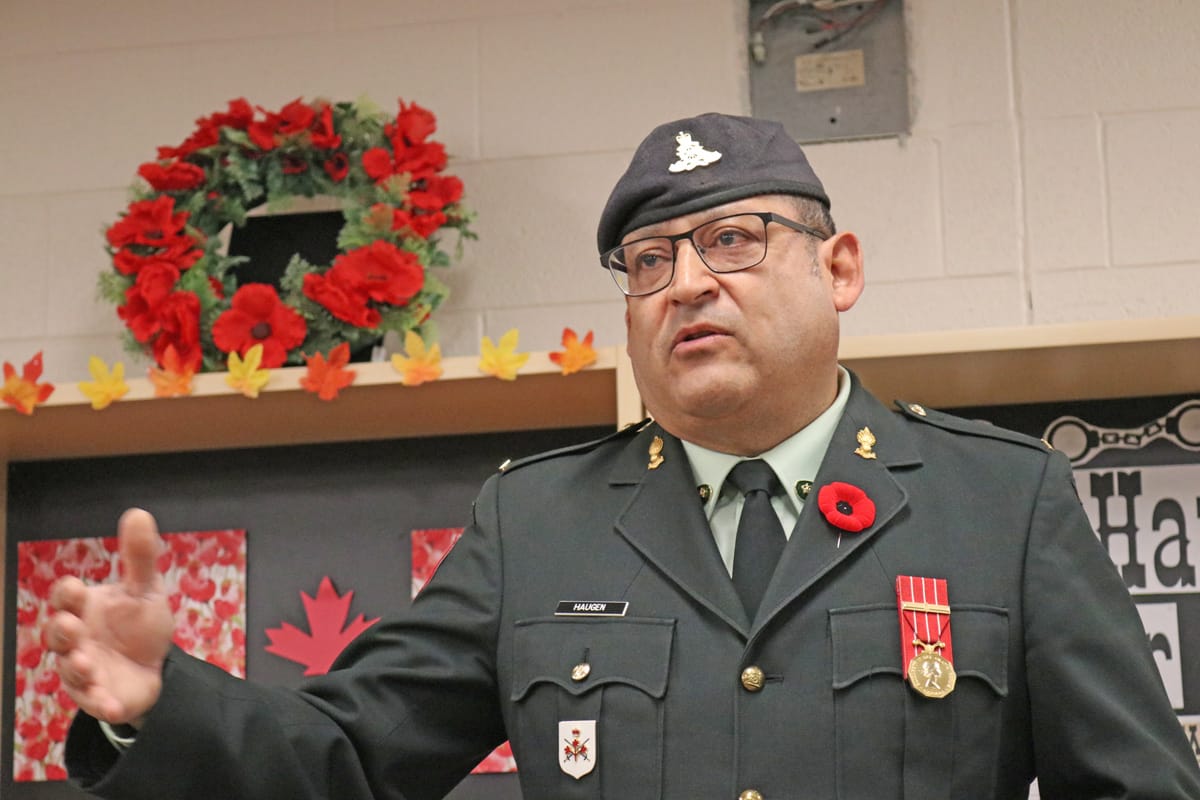
Master warrant officer Edwin Haugen is now a Deputy Sgt. in the 56th Field Artillery Regiment, currently brigaded with 11th Field.
He began serving at 17.
Haugen oversees recruit training and ensures technical artillery courses are up to standards.
“We’re always looking for members that want to join,” he told students. “It is a good career in the reserves.”
Haugen’s reserves take on tasks such as Arctic sovereignty and avalanche control.
“We get trained for cold weather and deploy to the Arctic for two weeks,” he added.
Haugen stressed the risk involved in being a reservist.
“When you put this uniform on ... we do suffer casualties,” he said. “Some of the soldiers that were injured in Wainwright were reservists.”
Captain Rod Pettigrew served with the 11th Field Artillery Regiment at 16 years old and has been married to Elaine for 60 years.
He has over 45 years of service to his country.
Pettigrew first signed up because “playing soldiers looked good.”
Three of his friends decided to deploy to Vietnam. One went into the Air Force, one to Medic Corps and last to the U.S Marine Corps.
“Only two came back ... low and behold that was kind of taxing on you,” Pettigrew said.
He had hoped to follow his friends overseas but due to his age, he need parental permission. Pettigrew’s mother wouldn’t sign his papers.
“I decided to stay in the military in Guelph with the 11th Field Regiment,” he said.
Pettigrew has worn many hats during his service, becoming the army’s top sergeant major in Ontario.
“November 11 ... is a very sombre thing to those that serve, because we had friends that are not here today because they were demised,” he said.
Remembered veterans
Veterans who have been on the panel and are now deceased include:
- Frank Taylor;
- Steve Nessner;
- Bill Winegard;
- Col. Frank Bayne;
- Grant Johnson;
- Eleanor “Bobby” Freeman;
- Troop Sgt. Major Mario “Skin” Zecca;
- Bill Irving;
- Ted Ford; and
- Bill Seifried.
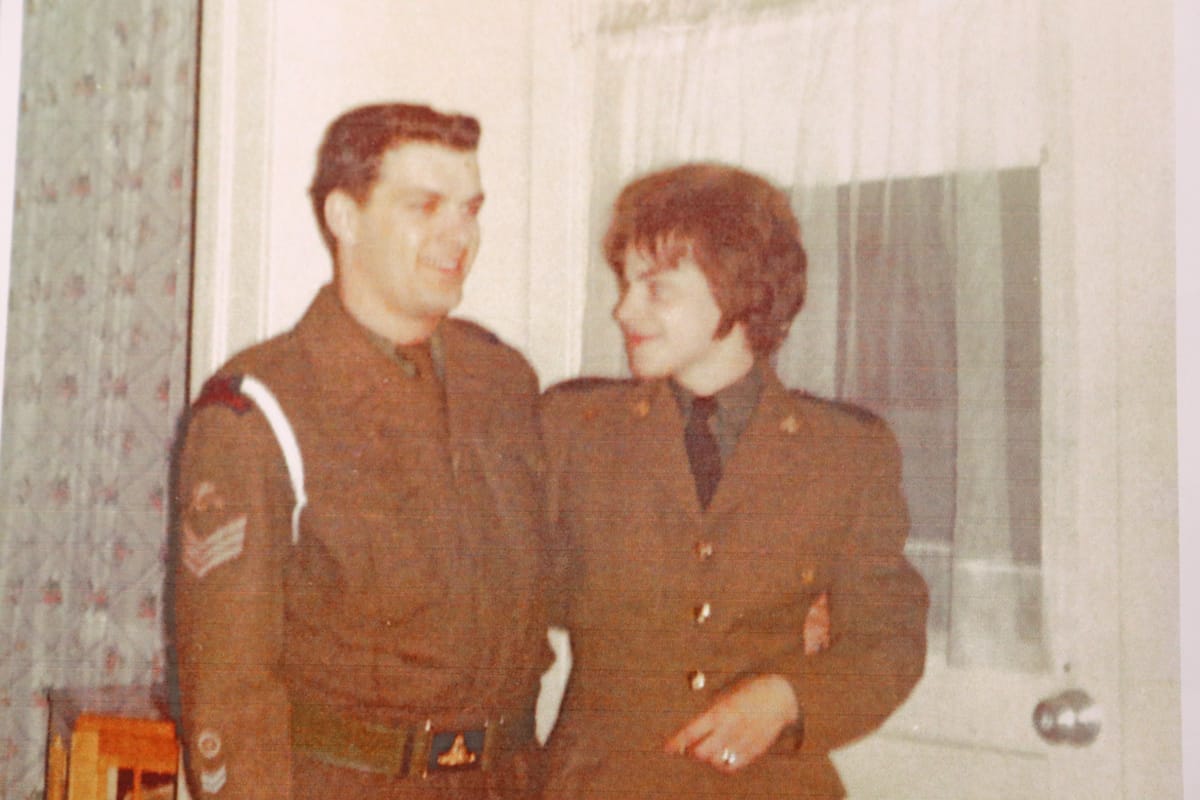
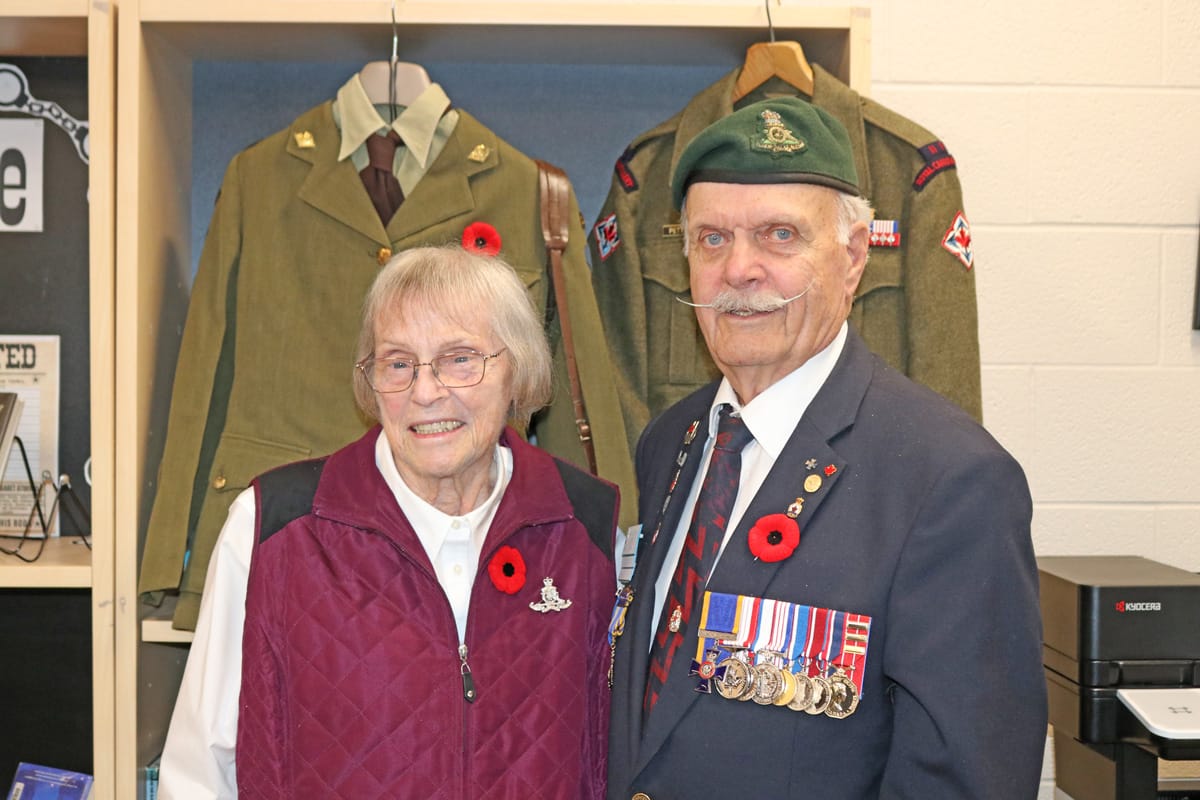
LEFT: Rod and Elaine Pettigrew in their early years of serving. They have been married for 60 years. RIGHT: Rod and Elaine Pettigrew standing with their old military uniforms.


