

Communities across county rallied to erect cenotaphs


WELLINGTON COUNTY – Southern Wellington County is home to six cenotaphs, each with its own unique history.
They were erected to honour the brave men and women who have fought and sacrificed for our country in various conflicts throughout history and the world.
Belwood
On Feb. 22, 1919, a women’s group called the Daughters of the Flag delegated to the Township of West Garafraxa, now amalgamated as part of Centre Wellington, asking permission to use the north corner of Market Square for a cenotaph.
In the summer of 1920, the West Garafraxa Township Memorial Committee visited Cater and Worth Marble and Monuments in Galt. They chose a statue of a soldier carved in Italian white marble, standing at ease beside a grey granite stone with the names of the fallen set in metal lettering.
The engraving was completed by Cater and Worth, while the life size statue is the work of Italian sculptors and was imported from Italy.
In a ceremony on July 31, 1921, the cenotaph was unveiled by former township Reeve John Gregson, whose son David Gregson was killed in 1915, and by 16-year-old Robert K. Hanna, who lost his father, John Sidney Hanna, in 1917. The cenotaph was rededicated on June 29, 1946.
The statue was removed in 2008 because it was showing considerable wear, and a granite replacement statue was installed. The original statue was restored by conservator Patty Whan and now stands outside the archives wing of the Wellington County Museum and Archives in Aboyne.
Elora
Eleven years had passed from the end of the Great War until the dedication of the war memorial.
The war had affected Elora profoundly, but initially there was no consensus on how or even whether it should be commemorated. For the first few years after the war, a piece of captured German artillery served as a monument to the war.
In the fall of 1928, the Elora War Veterans Association’s delegation of Jim Quinn, Gord Duncan and Fred Magnus took the idea of a war memorial to council and asked for funding. The committee began work early in 1929 under the leadership of grocer E.C. Grimes, who had been a captain in the army. Residents were canvassed to choose a location and over 70 per cent favoured in front of the town hall. Additional money for the cenotaph was raised through fundraisers and donations.
Design proposals were considered during April and May of 1929, and the Hunter Granite Works proposal was chosen. Its design, the work of Captain George Hunter of Simcoe, included a 16-foot-high column, on a 9-by-10 base, all made of La Casse granite from southern Quebec. After some minor changes, his plan was adopted. Hunter’s design included the names of the Elora men who died and the major battles in which they took part. The engraving included symbolic elements: two Crusaders’ swords, symbolizing the fight for a just cause; a cross, symbolizing the sacrifice of those who died; and a wreath of maple leaves, to identify the men with the Dominion of Canada.
Town council contributed the majority of the funds, with the remainder raised by the Rebekah Lodge through sales of poppies, and by donations that were solicited right up to the last week before the unveiling.
The Elora cenotaph was dedicated to those who died in the Great War on Nov. 10, 1929. A temporary platform, draped with Union Jacks, was put up in front of the town hall for dignitaries. The front of the town hall was covered with red, white and blue bunting. Smaller flags were strung on lines in front of the building, and the monument itself was covered with a large Union Jack. Margaret Fisher, the first mother to lose a son, unveiled the cenotaph.
Bordering the cenotaph is an outline of a maple leaf. The Second World War and Korean War inscriptions were added later.
The cenotaph is maintained by the Township of Centre Wellington.
Fergus
In 1919 discussions for a war memorial commenced and a committee was struck. A site was chosen – Union Square – and ideas were put forward however, the promised memorial never materialized.
Frustrated by years of inaction, Dr. Norman Craig, a surgeon and a veteran of the Great War, decided to do something. To raise funds for the memorial, in 1933 he wrote and staged a play based on his experiences in the war: You’re Lucky if You’re Killed. The newly formed Fergus Legion and Dr. Craig helped to plan, pay for and build the Fergus cenotaph, which he later called “a small, overdue payment on a large debt.”
The cenotaph unveiling on Aug. 5, 1935 was attended by thousands and broadcast to many more via radio. Following Dr. Craig’s death in 1964, the memorial park was rededicated in his honour.
The cenotaph is maintained by the Township of Centre Wellington.Erin
The Erin cenotaph memorial was dedicated on Nov. 11, 1956, to veterans and local men killed in action in the First and Second World Wars. Plaques have subsequently been added to recognize the Korean War, post-war operations and Afghanistan.
It was erected by the Royal Canadian Legion Branch 442. The unique three-sided stone and brick construction has one side dedicated to each of the major conflicts of the 20th century.
The cenotaph was restored in 2012, at which time the plaques were removed for corrections and additions. Research by Phil Gravelle led to Alexander Cochrane being added to the list of First World War soldiers in 2015.
The cenotaph is maintained by the Town of Erin.
Rockwood
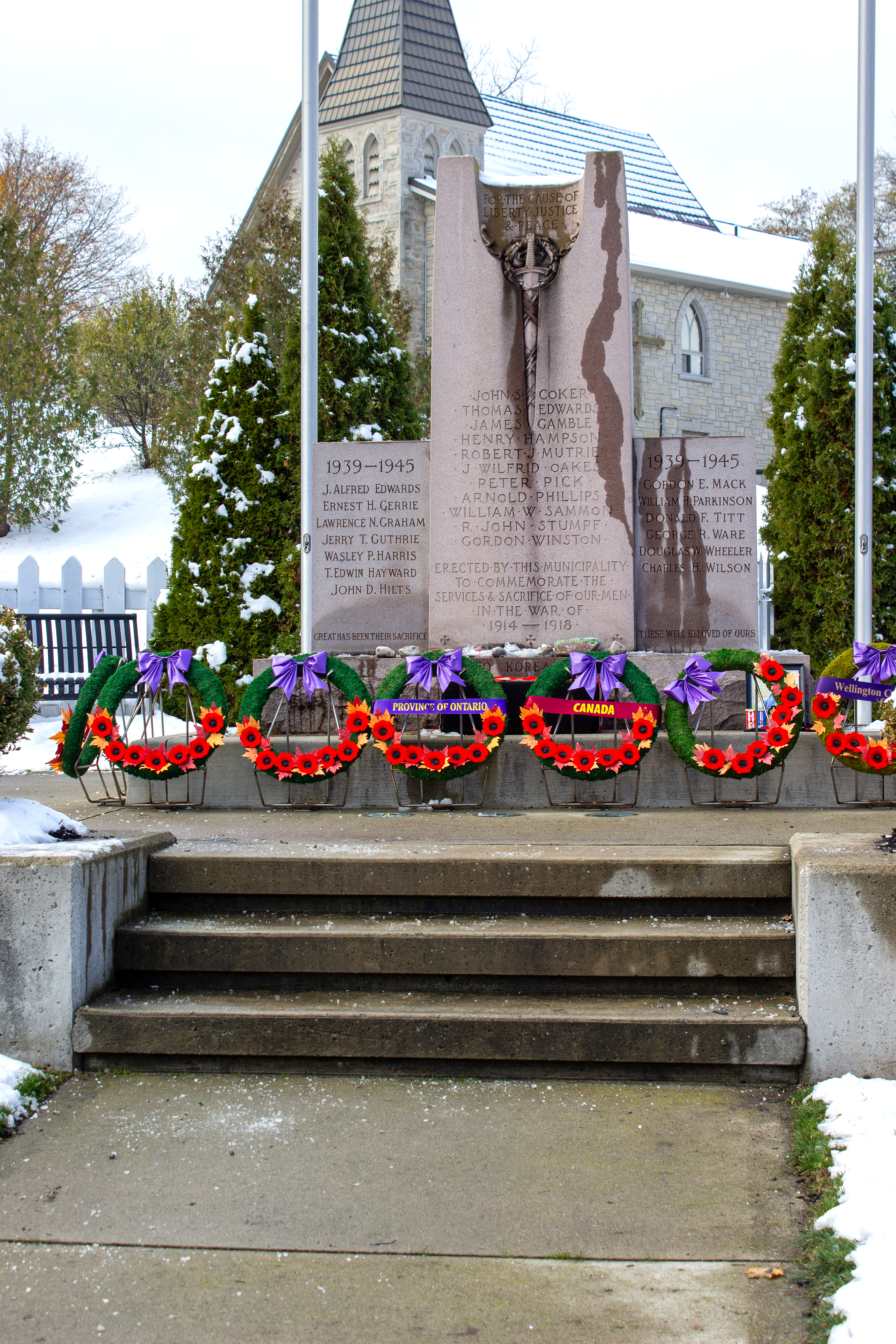
Rockwood, formerly Eramosa Township, was the first municipality in Wellington County to build a monument to its fallen soldiers after the First World War.
A committee of citizens approached council with their plans for a memorial on Feb. 17, 1919. William Harris, A. Fraser Auld, John Grieve, Robert Harwood, Norris H. Black and L.R. Guild proposed that the fownship fund all or at least a substantial part of the costs.
On July 28, representatives of St. John’s Anglican Church, signed an agreement for the cenotaph to be erected on a corner of the church property, provided the township committed to maintaining the plot. In a formal resolution on Aug. 4, council unanimously agreed to these terms.
Rockwood held a special half-holiday for families on Aug. 28, 1919, beginning with an unveiling of the monument by William Reid Clark, Bishop of Niagara.
Among the speakers was former Eramosa Township Reeve Lieutenant-Colonel John Mutrie, a veteran whose son Robert John Mutrie had died in Belgium in 1916 at age 33. About 50 veterans marched from Waterside Park to the cenotaph, and two bands from Guelph came to provide the music. The attendees later walked to the Agricultural Park to enjoy a luncheon, baseball, races and speeches from local dignitaries.
The cenotaph is built from granite and is decorated with a sword and wreath. In 2000, two wings were added to the memorial in memory of the Second World War.
The cenotaph is maintained by the Township of Guelph/Eramosa.
Aberfoyle
More than half the funds for a Township of Puslinch memorial to honour those who served and died in the First World War was raised by donations at public events, including a 1919 welcome reception for returned soldiers in Morriston, featuring a baseball game, supper and a concert on the school grounds.
Over $2,000 was raised by the citizens of Puslinch and the township provided the remainder.
The committee responsible for the memorial was led by Reeve Hugh Ross and included representatives from patriotic groups, community leaders and mothers. Women’s groups were responsible for a large part of the event planning and fundraising. The memorial design was selected by June 1919 and purchased from a supplier in Kitchener.
The cenotaph was unveiled the following year, on June 3, 1920, by Reverend Buckland, MPP for South Wellington. The unveiling was an all-day event that included a welcome to returned soldiers, who each received a gold locket and chain from the Township of Puslinch, as well as a banquet at the Aberfoyle Fair pavilion hosted by Women’s Institute president Mrs. Hohenadel.
Later, inscriptions were added to honour the Second World War and on June 3, 1949, a memorial service was held at the memorial. After the Korean War, an inscription was added for that conflict.
The cenotaph is maintained by the Township of Puslinch.
Arthur
Arthur Enterprise News editor Rixon Rafter first proposed the idea of a soldiers’ memorial in December of 1918, just one month after the end of the First World War.
The following year, a group of local women under the name Women Memorial Workers suggested a cenotaph be constructed at the corner of George and Frederick Streets. Despite some residents’ objections to the location, council agreed with the group and purchased the land for $500.
The project was funded through donations, bazaars and other contributions.
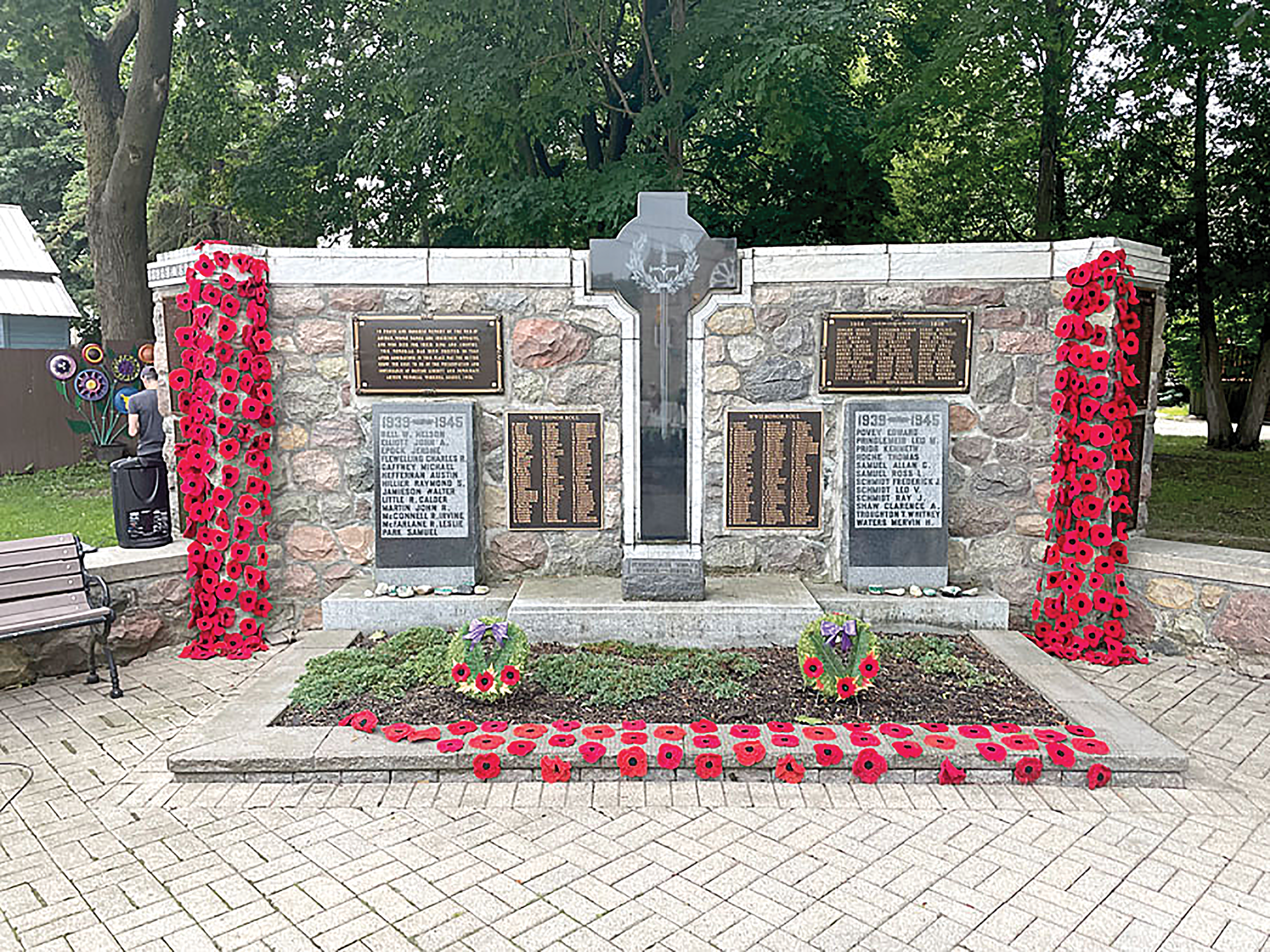
The Arthur cenotaph was built using stones from local farms and was the first fieldstone cenotaph built in the province.
The construction of the cenotaph was overseen by architect Major J.M Gibson, who was raised in Arthur and had commanded some of the local soldiers overseas, and Ed Doherty, a local stone mason.
The marble slab in the centre of the cenotaph was donated by the federal government and depicts a cross embedded in the marble.
The cenotaph was officially unveiled on Aug. 6, 1923 by Mary Brocklebank, president of the Women Memorial Workers, whose son died due to wounds sustained in France in 1918.
Also present was Margaret Chambers, who had lost her son, Private Robert Chambers to the war.
In January of 1930, the cenotaph and the park in which it resides were turned over to the town along with a bond of $11,000 for perpetual care.
In 1970, Dutch citizens donated benches and lights to the park in thanks for the Canadian Liberation of Holland during the Second World War. In 1995 the cenotaph was rebuilt to bring the plaques from different wars together. Also in the same year, a homecoming committee unveiled a memorial recognizing Arthur as Canada’s Most Patriotic Village.
On Sept. 16, 2000, the Royal Canadian Legion Branch 226 unveiled four plaques honouring those who served and came home, including those who served in the Merchant Marine and Korean War.
In 2010 a plaque was added by the Arthur and Area Historical Society and Arthur Revitalization Committee, recounting the work of Women Memorial Workers.
The two statues placed at the cenotaph in 2011 were a project of the local Legion and in 2016, 700 red and white tulips were planted at the front of the park from Holland.
Today the cenotaph is maintained by the Township of Wellington North.
Mount Forest
On April 16, 1928, 10 years after the First World War, residents Robert Galbraith, Dr. G.P. Allen and F.J. Noonan delegated to town council.
During their delegation, the group disclosed that an anonymous donor had pledged $1,000 towards a memorial for fallen soldiers. Town council agreed to match the $1,000 pledge and construction on the Mount Forest cenotaph began.
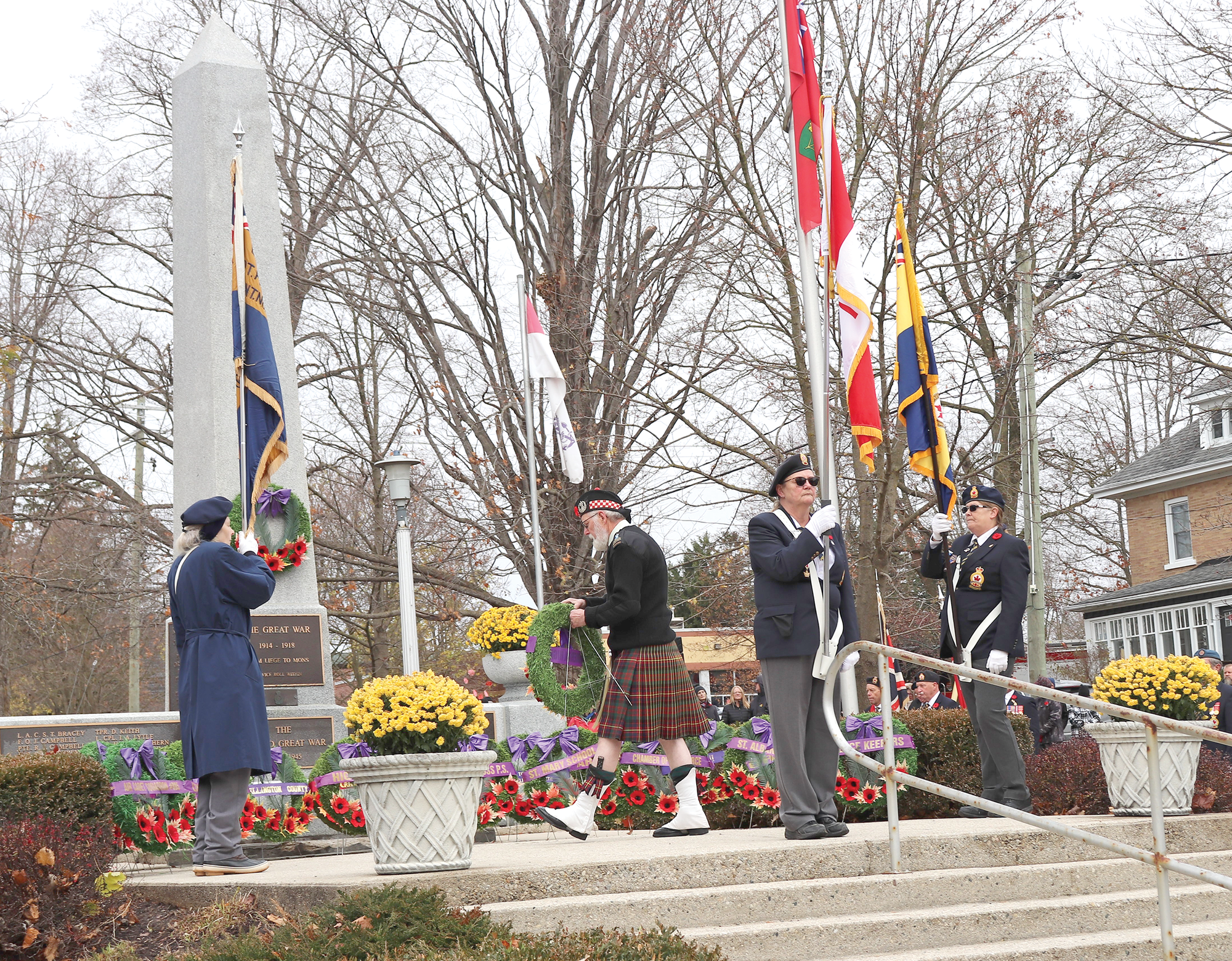
The cenotaph is carved from blocks of gray granite and was designed and built by A.J. Corbett and engraved by Adam Walker.
Captain Frederick W. Campbell was the first Canadian to be awarded the Victoria Cross during the First World War and was killed in action in Givenchy in 1915. On Oct. 15, 1928, the cenotaph was officially unveiled by his widow, Margaret Campbell.
The cenotaph was re-dedicated in 1964 to honour those who died in the Second World War.
The Mount Forest cenotaph is located on the corner of Highway 6 and Parkside Dr. and is maintained by the Township of Wellington North.
Clifford
Erected in 1925, the Clifford cenotaph was spearheaded by the village council and was funded through a tax rate increase.
It was constructed to commemorate those lost in the First World War. Following the Second World War, two more names were added to the cenotaph.
The structure is carved from Stanstead grey granite from Quebec, and the names of the fallen soldiers are inscribed in raised lead.
Because Clifford lies on the border of Wellington and Huron counties, its citizens wanted the memorial to honour local war heroes without regard for municipal boundaries, leading to some names being inscribed on several surrounding cenotaphs as well.
One name in particular, Private Douglas Bates, is featured on three cenotaphs: Clifford, Harriston and Fordwich.
The Clifford cenotaph was restored in 2011, and the project was spearheaded by Stuart Douglas and the Rotary Club.
The cenotaph is maintained by the Town of Minto and is located at 8 Clarke St. N in Clifford.
Drayton
Initiated by the Drayton Women’s Institute, led by president Isabel Henderson, the Drayton cenotaph was constructed to commemorate soldiers from the Townships of Maryborough and Peel (now Mapleton).
The cenotaph consists of a stone pillar topped with a ring of electric lights and a tablet listing the names of the fallen soldiers of the First World War.
The structure was officially unveiled on July 27, 1927 by Ontario’s Lieutenant Governor W.D. Ross.
Three names were added to the tablet in later years, and after the Second World War, the names of the fallen soldiers from that war were added.
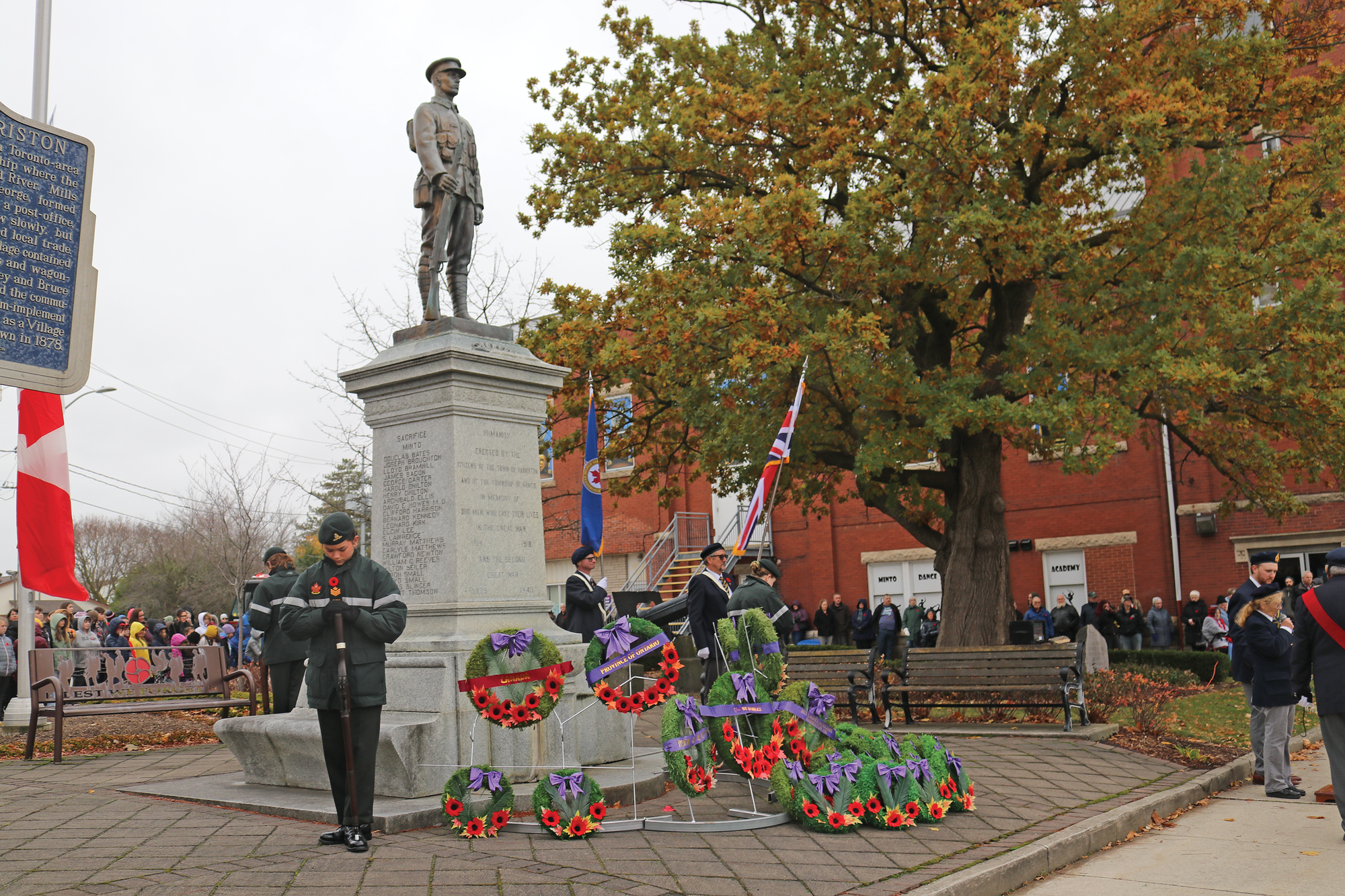
Harriston
In January of 1918, Minto Township and the Town of Harriston addressed the need for a monument to commemorate the many local men who sacrificed their lives in the First World War.
Delegates from each community formed memorial committees, led by judge Anson Spotton in Harriston and Richard Wilkin in Minto.
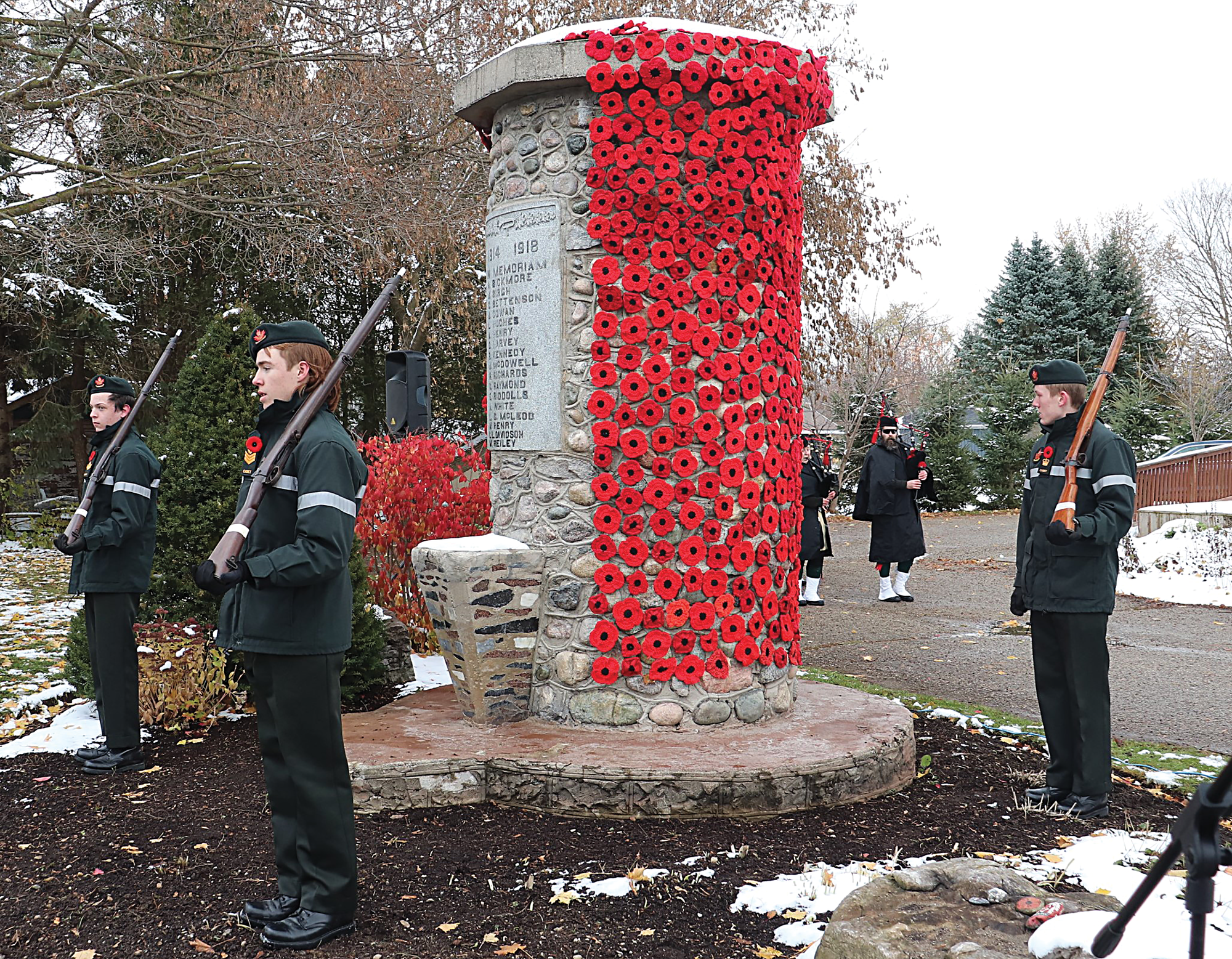
By 1919, a location was chosen – the intersection of Elora Street South and Mill Street (Veteran’s Way) in Harriston – and in January of 1920 residents voted in favour of the installation of a memorial drinking fountain.
Each municipality’s share of the funds was drawn from the year’s property tax. William J. Welch, a monument dealer in Harriston, was in charge of construction of the bronze and granite monument, assisted by J. H. Mundy, who supplied the water pipes for the fountain, and John Tilker, who laid the pavement.
The cenotaph was unveiled on June 11, 1922, with, more than 2,000 people in attendance.
Inscriptions were later added to honour the Second World War.
The cenotaph is currently maintained by the Town of Minto.
Palmerston
Just after the First World War, Reeve J.B. Skelton chaired a citizens’ committee with nine members, including several who had lost sons and relatives in the war, to discuss a war memorial.
In August 1919, Palmerston’s citizens chose a Carrara marble statue of a soldier at ease, standing atop a grey granite base.
The cenotaph was funded by town council, delivered by W.J. Welsh and installed on Dec. 15, 1919. It was officially unveiled the following year, along with two German machine guns, which were donated as scrap during the metal drives of the Second World War.
Many names of those who died in the First World War were added to the cenotaph in subsequent years, including the names of eight soldiers who returned home.
The reason for these inclusions is not known - over 150 Palmerston residents enlisted, along with many others who had local connections.
Later, inscriptions were added to honour the Second World War and the Korean War.
Located on Bell Street, the Palmerston cenotaph is maintained by the Town of Minto.
*SOURCE: veterans.gc.ca/en/remembrance/memorials.


