

Advocates push back against Bill 33, policing in schools


GUELPH – “Fund our schools, not policing in schools.”
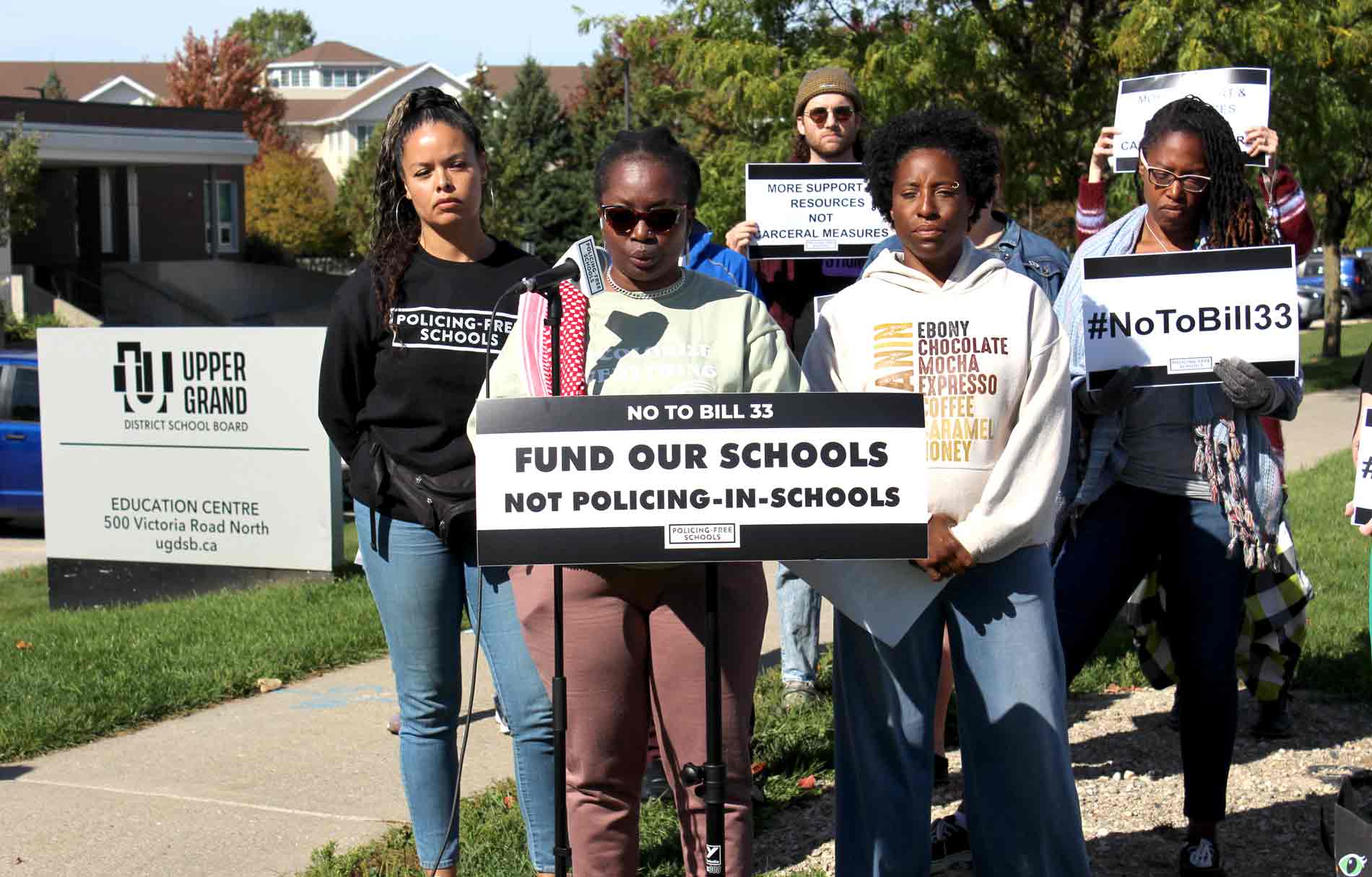
That was the resounding message from a group gathered in front of the Upper Grand District School Board office (UGSDB) on Oct. 2.
About 20 people stood side by side with signs that read “#NoToBill33” and “More supports and resources not carceral measures.”
The gathering, organized by the UGDSB Black Parent Council and Policing-Free Schools, highlighted what organizers say are problems with Bill 33.
It was a stop on a provincial Policing-Free Schools tour calling for opposition to the bill and for decreased policing in schools.
If passed, Bill 33, coined Supporting Children and Students Act, would amend the Education Act to enable the Minister of Education to take over boards that don’t comply with provincial direction, give the minister power to implement financial policies within boards and force them to implement school resource officer programs.
School resource officers are designated police officers who patrol schools daily chatting with students and looking into illegal activity.
[related]
The UGDSB had a school resource officer program until 2021. It was cut after a year-long review prompted by Black Lives Matter Guelph.
Rockwood resident Nia James said “Bill 33 does not support or protect students.”
“As a parent advocate, as a cofounder of the UGDSB Black Parent Council and as an [Ontario English Catholic Teachers’s Association] member I know the cost when children are treated as problems to be managed instead of people to be nurtured,” James said.
“I also know the power of schools where children are met with dignity, care and opportunity. The difference is everything.”
She said, “We know from research, from community testimony, from student voice and from our lived and living experiences that [policing] does not create safe schools or thriving conditions for students to learn.”
Instead, James continued, “policing in schools erodes trust, creates fear, and pushes children out of classrooms and away from community” and most negatively affects minority groups.
Policing-Free Schools director Andrea Vásquez Jiménez said “although we are in front of the UGDSB, I want to make it clear that Bill 33 has detrimental implications for all students, parents, caregivers, educators and school communities, including those served by the Wellington Catholic District School Board (WCDSB).”
She called the bill a “distraction from the real issue — a chronically underfunded public education system” and “a power-grab seeking to further centralize government power ... placing profit over students and towards dismantling school boards as we know it.”
Policing in schools, Vásquez Jiménez added, is “non-evidence based, fiscally irresponsible and harmful.”
Education Minister Paul Calandra’s press secretary Emma Testani, told the Advertiser “school resource officer programs help foster positive relationships between students and law enforcement, ultimately making our schools safer.”
Testani said Bill 33 will ensure funding goes to classrooms, and that if boards mismanage cash, the ministry “will not hesitate to act.”
UGDSB and WCDSB officials refused to make anyone available for an interview.
WCDSB spokesperson Bianca Pettinaro said in an email the board’s position has not changed since December, when education director Mike Glazier told the Advertiser the board is happy with the school resource officer program.
Also in an email, UGDSB spokesperson Heather Loney said the board wouldn’t comment on Bill 33 without further direction from the ministry.
The UGDSB, Loney said, has a “good working relationship” with local police services and actively and regularly engages with police.
Loney added the board “does not have a police resource officer program, and there have not been any discussions about reinstating such a program.”
However, during a June Guelph Police board meeting, Chief Gord Cobey said discussions were taking place between UGDSB and city police about re-implementing a school resource officer program.
He said Guelph Police would “absolutely be expanding our resource officer program to support them,” referring to the UGDSB.
Guelph Police did not respond to the Advertiser’s question about the discrepancy, and Loney was unable to explain it.
Wellington County OPP did not provide comment before press time.
At last week’s gathering, speakers also expressed concerns with the province’s rhetoric around eliminating elected trustee positions, and what the group suggested was a future of privatized school boards through Bill 33.
University of Guelph adjunct professor of Black resistance and organization Dr. Marsha Myrie Obie said policing in schools is “an approach to education from the same playbook as residential and industrial schools.”
“If we want a world removed from colonial logics – anti-Black, anti-Indigenous, hate-filled logics, then the curriculum that we engage in K to 12 becomes an important mechanism of social change.”
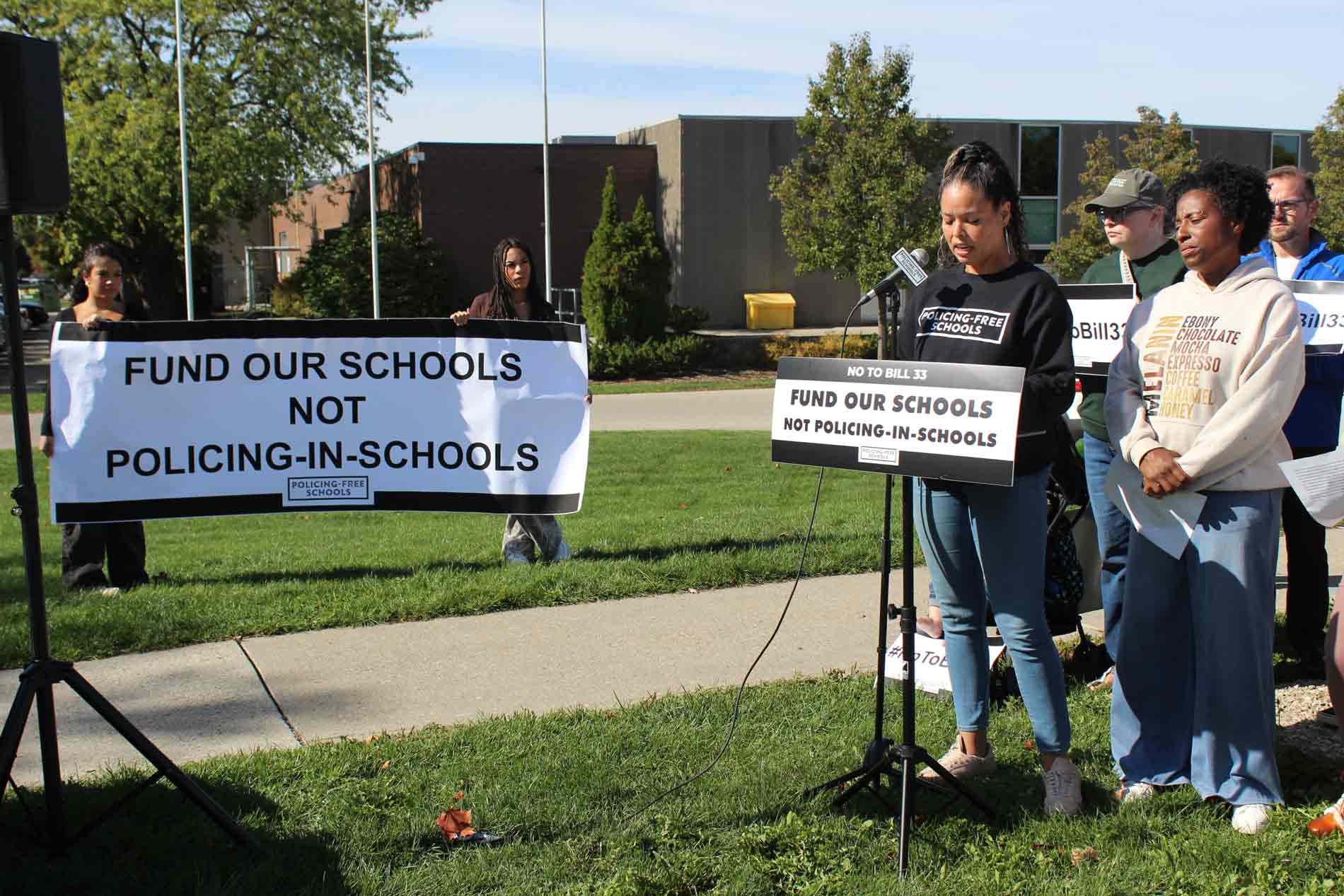
Myrie Obie asked local school board trustees and administrators to “listen in humility and honesty” to community members and to engage in “open dialogue.”
She said, in part, Black and Indigenous communities across Canada have been calling for less policing in schools for years.
“When we recognize that there are thousands of pages of research material which show the harm of policing approaches to school ... we have to ask ourselves: ‘What is the decision to police schools really based in?’” Myrie Obie said.
“Spending educational funding to properly resource schools for every student – be they disabled, neuroexpansive, Black or traumatized – is the duty of policy makers. It is the solution to issues in our schools.”
James called on board trustees and administrators to take “tangible and measurable action” informed by research about the impacts of policing in schools.
She said safety “comes from investment in evidence-based supports that our students and families have been calling on for years.
Vásquez Jiménez called on all trustees and administrators to organize collectively with parents, students and school communities to push back against Bill 33.
“It’s time to rise up,” she said, “And not be silent through this culture of fear and intimidation that your school boards will be taken over, because we know where silence leads.”


