

Have a small garden? Think about growing up


My garden is tiny, well actually, the property is tiny, my garden is big. Crammed with colour, texture, varying heights, and blooms that transverse three seasons, evoking childhood memories of my mother’s garden.
How many plants can you squeeze into a tiny place?
Lots, because if you can’t go out, go “up” by using tall plants, vines, hard-pruned small-trees and shrubs, and hanging pots.
Integrate them throughout your garden; create the illusion of being within.
Perhaps the fastest way to go “up” is with vines; most are quick to establish and easy to grow.
Place them throughout your garden. Make sure to consider how they climb as this dictates the kind of support they need.
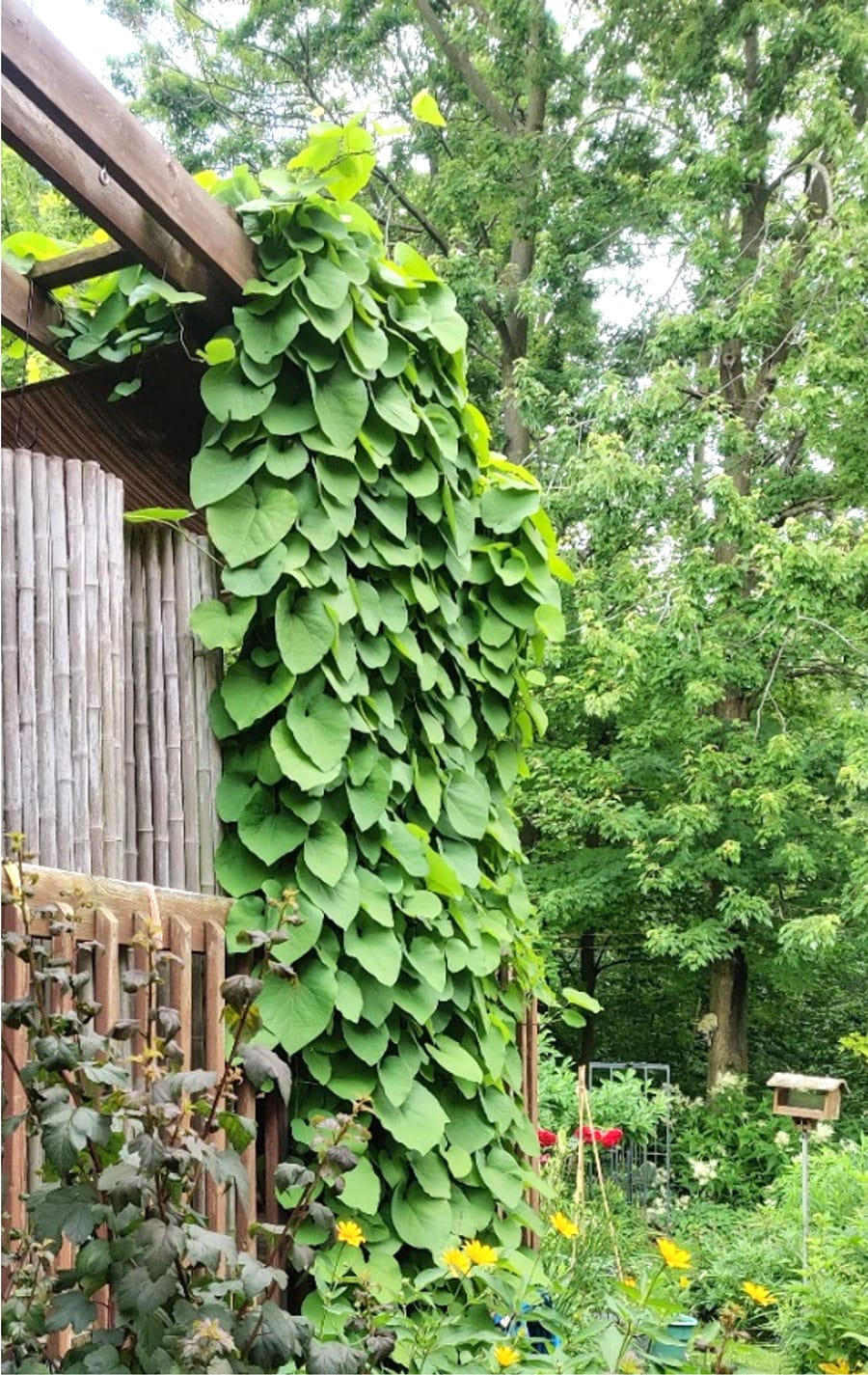
They can be wrappers with twining stems, leaves, or tendrils which need trellis-like supports; they can be suckers with aerial roots that will cling to surfaces, or hookers that use thorns to hook onto things. And there are also ramblers that can be directed or left to grow up and about.
I use annual vines to add a splash of colour, growing most from seed. They include:
- Sweet Peas (Lathyrus odoratus) uses tendrils;
- Morning Glories (Ipomoea purpurea), a twiner;
- Fire Cracker Vine (Mina lobata), a twiner;
- Climbing Nasturtium (Tropaeolum majus), a rambler; and
- Runner beans (Phaseolus coccineus), an edible twiner.
And then there are my perennial vines. Among these are:
- Clematis (Clematis spp.), a must-have, adding a splash of colour throughout the season. These woody vines are leaf wrappers, using their petioles to wrap onto supports. There are many species and varieties, and can be chosen for different heights, colours, bloom sizes, spread, and blooming times;
- Dutchman’s Pipe (Aristolochia macrophylla), my all-time favourite, a woody vine that twines its way up a trellis. Growing up to 20 feet tall and wide, it is native to eastern North America. Small, unusual, pipe-shaped flowers arrive early, followed by large heart-shaped leaves that create a screen of privacy. Slow to establish, but worth the wait.
Tall perennial and annual plants are also effective.
Make sure to select the taller varieties as many breeders are producing shorter cultivars.
Examples include:
- Joe Pye Weed (Eutrochium purpureum, formally Eupatorium);
- Sneezeweed (Helenium autumnale);
- Garden Phlox ‘David’ (Phlox paniculata ‘David’);
- Fern-Leaf Yarrow (Achillea filipendulina);
- White Fleece Flower (Persecaria polymorpha), and bonus, will grow in dry, part-shade;
- Giant Iron Weed (Vernonia gigantea), my all-time favourite, an eastern North American native, reaching over 10 feet tall with rich magenta blooms in late fall; and
- Not to forget the whimsical annual, Kiss-Me-Over-the-Garden-Gate (Persicaria orientalis), that pops up here and there, towering over nearby plants.
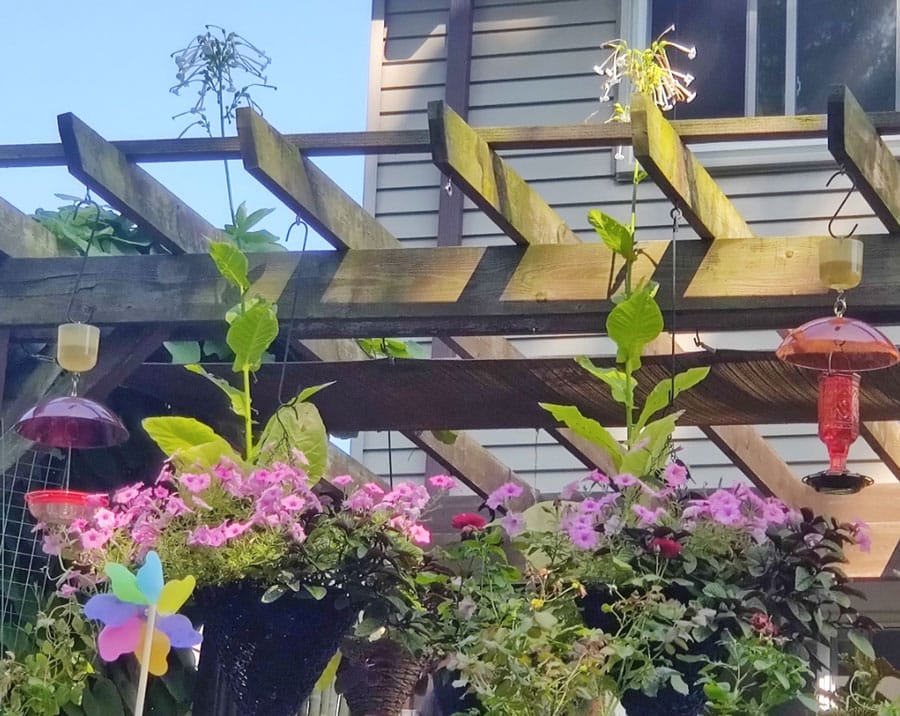
I also hard prune a number of smaller trees and bushes to encourage upward growth. And then there are hanging pots, which are great for adding a pop of colour.
Our gardens are a very personal part of us, and often, a labour of love. In my case, a garden doesn’t have to be orderly; there is no rule that tall plants need to be placed in the rear.
Going “up” allows you to create the impression of space and the feeling of being within, and I can’t imagine a better place to be.
By Louise Milton, Guelph-Wellington Master Gardener


