

‘Exactly what the tartan should be’: behind the Scottish festival’s anniversary design


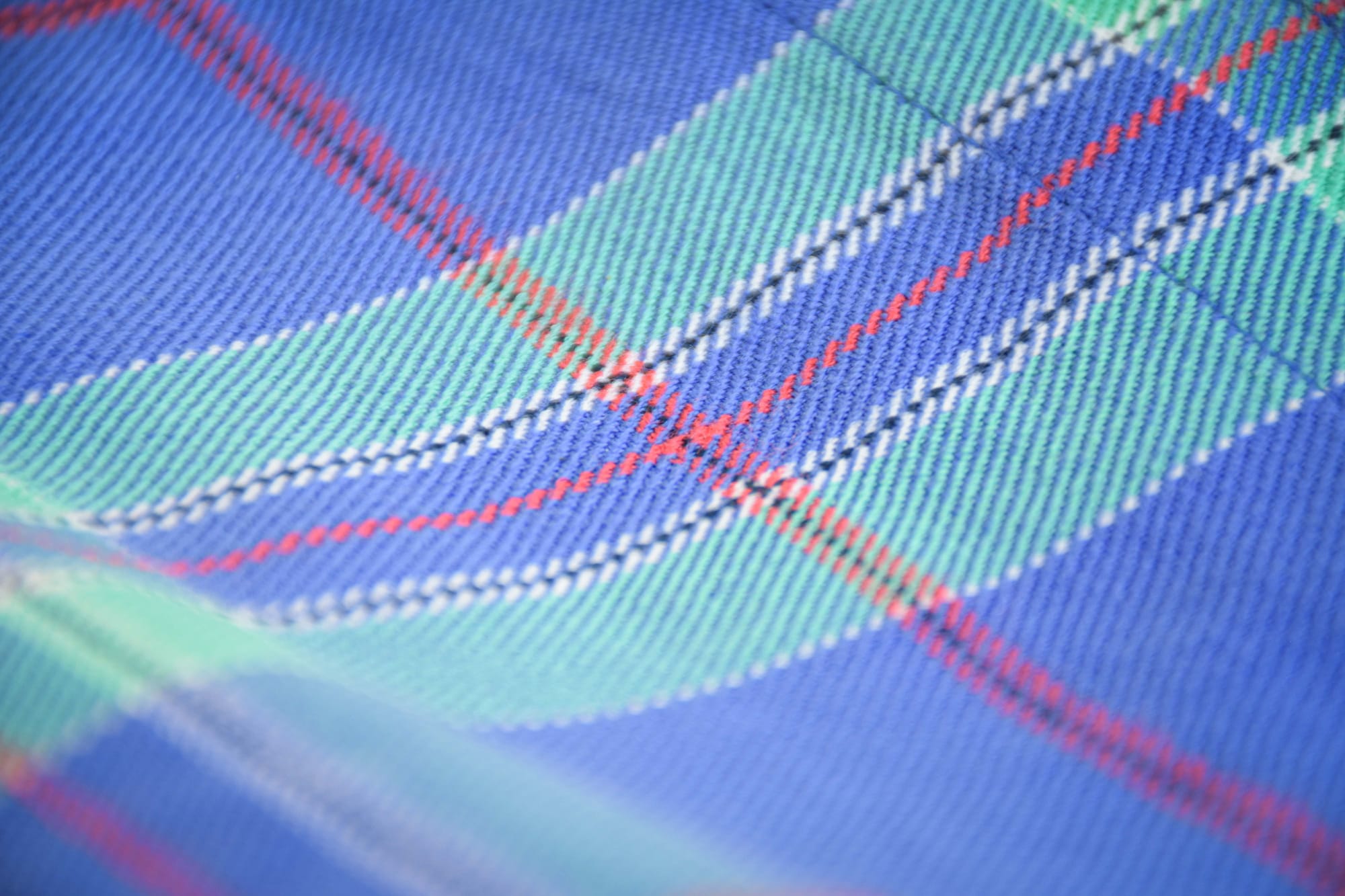
FERGUS – Immediately as Robert Paterson saw the six-inch swatch of white, blue, red and green lines he knew he had gotten it right.
Eight white diagonal threads signify the eighth month, 17 blue threads represent the 17th day, and 46 more threads, these green, mark the year the Fergus Scottish Festival and Highland Games debuted — Aug. 17, 1946.
“The colours: they just pop,” said Paterson, who designed a special tartan for the festival’s 80th anniversary.
The festival’s red, white, green and blues are bold, the threads almost melding into each other as they warp and weft, criss-crossing on the fabric swatch, Paterson said, before repeating to create a symmetrical pattern.
Paterson wanted something less busy – fewer lines, he said – than some of the patterns representing Scotland’s clans on kilts worn around the festival.
[related]
It’s a relatively simple design, he offered, but that doesn’t mean understated.
“This is exactly what the tartan should be,” he said.
The Keeper of the Records of Scotland and a review panel have approved the tartan to be included in the Scottish Register of Tartans.
Paterson said a one-inch woven sample will travel over the Atlantic and join others kept in Edinburgh.
Ross Truslove with the National Records of Scotland said the festival tartan will join a catalogue of 10,364 unique patterns.
Festival director Elizabeth Bender said 350 scarves and 100 kilts bearing the anniversary tartan were ordered.
“The kilts are all gone,” Bender told the Advertiser.
She said a “humongous list of people” have inquired about getting their hands on one since.
It may just be her role, but Bender wears kilts all the time, she said.
“You find a kinship you didn’t necessarily know that you had,” she explained.
Bender believes the anniversary tartan will become a “treasured keepsake” marking the festival milestone.
“We’ll see people wearing them for years to come,” she said.
A tartan is essentially a length of multi-coloured woven fabric with a checked pattern. It’s different from plaid, which describes a garment, not the design.
Once worn by Highland warriors and Scottish families, a tartan design could, over time, become associated with a particular group.
It became a symbol of kinship, as though signalling a surname or team in colours and patterns.
The tartans of today worn on kilts around the festival grounds are more likely to appear as a fashion statement.
“There’s nothing like wearing a kilt,” Paterson said.
What does he wear under his? “Just my socks and boots.”
Paterson hails from an Irish lineage of weavers and spinners and tries to make an annual pilgrimage back to his homeland of Scotland.
Today, he designs and manufactures modern tartans through the Patrick King Woolen Company, based in Port Hope, Ontario.
The Canadian War Museum, the George Washington Museum, and NHL teams have all commissioned his designs.
“It’s theirs, it’s a part of the Fergus games, it’s something they can be proud of,” Paterson said of his latest design.
The festival has no plans to retire a Ferguson tartan it adopted in 2023.
“One can never have too many tartans,” Bender said.


